

How to Keep Faith in Yourself as a Writer, with Jed Alexander
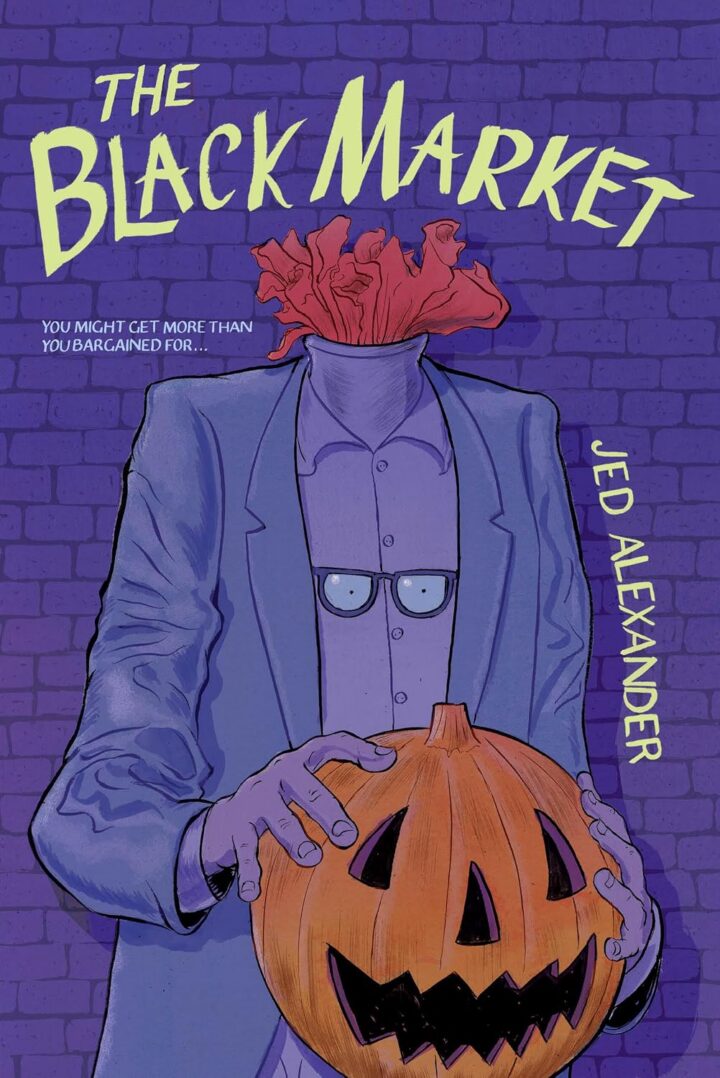
JED ALEXANDER IS THE author and illustrator of The Fairy Tale Color Collection, a series of children’s books that begins with the wordless 2018 book, Red, the follow-up 2022 book, Gold, and the third book in that series, Olive. His clients have included SpongeBob Comics, Cricket Magazine, Writer’s Digest, and the Children’s Book Council. His new book is The Black Market, a middle-grade book which he wrote and illustrated recently published by Union Square Kids. Listen in and read along as we discuss how to keep faith in yourself as a writer, and so much more.

Powered by RedCircle
Marion: Welcome, Jed.
Jed: Pleasure to talk to you.
Marion: Well, it’s a pleasure to read your work and it’s a pleasure to have you here. Like many people, when I had a child, I thought, Oh, I should be writing children’s books. And that didn’t happen. But it was one of those influences that I think happens to a lot of people. And this podcast is for writers. And I’m just sure that so many of them would love it. to learn how to do what you do or learn something about what you do. So let’s dig in and talk about it, okay?
Jed: Yes.
Marion: So in the fall of 2012, you made a hand-bound and hand-sewn book called Ella and the Pirates. According to your Amazon page, a lot of people asked you about the book and wanted the book, but you couldn’t make a hand-bound book for everybody. So you decided to do the next best thing and started a crowdfunding campaign on Kickstarter to raise money to publish mostly wordless, hard-bound book that would not only contain the complete 24-page Ella and the Pirates, but a number of other short stories as well.
And the campaign was a great success. And then you have to figure out how to get it out into the world. You don’t want to end up with a bunch of books, as many people do, who self-publish, and, you know, a big box of books in your garage. So you said that Marc Arsenault of Alternative Comics came forward to become the distributor and official publisher of the book.
And I think that’s a fascinating story. But my question is about the faith in oneself. Creatives need to have it. And so I really wanna talk to you about believing to that level that you were able to succeed like this. Where does this come from?
Jed: Well, it’s interesting. I remember when I first started, started to get published, traditionally published. I remember my friends saying, “Well, you know, you stuck with it.” And I didn’t think of it that way because it’s always been what I do. It never occurred to me not to do it, even though it took many years and I took many different paths. I tried editorial illustration, I wrote some horrible plays that, thank God, didn’t get produced.
I did a lot of things. But I was always writing and I was always drawing. And then when I decided to focus on kid lit, I just sort of honed in. And I had drawing upon the books I liked as a kid and what attracted me to books. And as comic books and books that were so appealing to me as a kid, I mean, that seemed to be a natural direction to go in.
And one thing I started with was I did some wordless writing. I’ve been drawn to that form because it’s hard and I like to do hard things. But I also just being able to tell a story, tell a coherent story, tell a story that’s compelling with just pictures. And it is writing, even though there are no words. And I think a lot of people misconstrue that. They’ll say, “Oh, great. You didn’t need a writer.”
Marion: Sorry. As a writer. Yeah. Those damn pesky stories. Difficult people. Yeah. No, that’s not at all what you’re saying. Yeah. Love that.
Jed: Yeah. My first book with Red was the first wordless book I’d done. And I had already written novels, bad ones, but my first traditionally published book was Red. And it was because my agent had shown this publisher what I had done with that mostly wordless Ella and the Pirates. And I had already put this book Red together on my own, the whole business. You’re not meant to do that. You’re meant to submit a book dummy. But I had already made the book and they had asked for a book dummy of a longer version of Ella and the Pirates, which I did.
And they rejected it and they said, do you have anything else? And I always have something else. So that was what I gave them. And I had plans for a series and I showed them little mock-ups for an idea for, at the time, Yellow and Blue were the names of those books that became something else.
And they were like, do you have a fourth one? You know, they were excited about it as a series. That’s great. But the third and fourth ended up with a different publisher for complicated reasons. They rejected the second book after it had already been finished and they still had to pay me the advance.
Marion: Well, that’s good.
Jed: Yes, that is good. And somebody else picked it up and it got a starred review from Kirkus and it’s reviewed in The New York Times. You know, success is the best revenge, you know?
Marion: Yeah, it is. So take us back to the kid you were. I read that you grew up in a small town in Pennsylvania where you first discovered your love of books at the local public library. So take us into that town library and show me where you headed first when you were a kid, what you picked up and what it did for you.
Jed: Well, I loved picture books and anything with pictures. And we… had this wonderful old library and the kids section was in the basement. It was a stone building. It was a very old stone building. I remember they used to have a sort of a kid’s corner where they’d make some kind of a theme every year or every few months, I guess. And then, yeah, I just devoured picture books in that basement.
Marion: That’s lovely.
Jed: My grandmother used to take me there. And yeah, I moved to California when I was eight. So I didn’t really discover middle grade. books or I was really interested in comic books at the time and I didn’t really read a lot until I was probably in fifth grade.
Marion: So in the publishing experience, we’re frequently told to write the book you most want to read. Yes. So what might be the dictum for children and middle grade writers? Do you have a particular kid in mind when you write and draw? Is it you? It is me. Yes. I was so hoping it was you. That’s so great. And he’s in there, that kid? You can talk to him?
Jed: Yeah, well, write the book you want to read. Yeah. And that helps you keep it moving, too, because, you know, it helps when you think of the kid that you were who would want to read this. It helps to say, what wouldn’t I be interested in here?
Marion: Yeah, that’s great.
Jed: It’s easier to cut out the boring stuff because kids are ruthless with their attention. And also it’s interesting, you know, with kids, writing for kids, you want that precise language. You want that language that really expresses the idea or the thought. But with kids, you want to get the right language and also you want the simplest language. Yes. That doesn’t mean simple ideas. It doesn’t mean that it’s not a complex story, but it forces you to really think about the economy of those words. You know, it was interesting.
I hadn’t written for adults for a long time or with adults in mind. And I wrote a Writer’s Digest article and all of a sudden I had all this vocabulary I could use. And I found to some degree it felt like a cheat. I wasn’t forced to consider my words as well.
And I found that I used language that I wouldn’t use for kids, but also I’m not sure if I made the best choices because I had that extra vocabulary. Yeah, so I was interesting to bounce back and forth like that. But I think writing for children may be a better writer in general. And it’s because of that cutting down to the chase. Like, what’s important here? What’s important about the scene? What’s important about the sentence? What do I need to express here? And what is absolutely not necessary?
Marion: Yeah, the idea of them being ruthless, that word really resonates with me because, yes, they can be bored, they can be completely distracted. And the other thing that I wanted to talk about with that three-book fairy tale series is you do a remarkable retelling in Red, the story of Little Red Riding Hood, to a very different fate. Gold, another wordless, fractured fairy tale that retells Goldilocks and takes it into the assumptions we have about family. And Olive, the retelling of Jack and the Beanstalk, And one of the hippiest things going in publishing is retelling tales.
In adult fiction, we’ve got bestselling books that retell the Odyssey, the Iliad, the story of Circe. And I’ve read all of them. I’m completely a mega-fan. But maybe you can help me understand why. What is it that draws us to the retelling of stories? I mean, and with kids, like maybe they don’t know the story or do you assume they already know Jack and the Beanstalk?
Just talk about the retelling. I assume they don’t know anything.
Jed: Yeah. Yeah. The fairy tales are just jumping off points. I’ve been interested in fairy tales. I remember Baba Yaga, the Russian folk tale. I really like that. And I’ve liked fairy tales, but this was just a vehicle to tell a story. They don’t really have much to do with the original fairy tales. You don’t need to be familiar with the original fairy tales. And you have to assume that in a lot of ways, this is one of their very first reading experiences. You know, the handful of books can be the first books you ever read.
And how we make schemas for different things based on the limited language we have. With bears, you have this bear that you’ve seen a photo of, or you’ve seen on National Geographic, or you have this bear that’s in a storybook, or you have this teddy bear or whatever, and these very limited vocabulary of what a bear is.
And so my bears might be their 10th bear. It might be just that very small realm of what they know and what they’re identifying. And also, you absolutely don’t want to underestimate them either.
Marion: Yes.
Jed: And you need those pages to keep turning. So every page, every spread has to be another reason to turn the page because kids are very ruthless. And if they get bored, they’re not going to want to turn that page. Having action on every page, giving the kid lots of things to find and discover. The books are meant to be reread or re-explored. And so there’s a lot of little… I wouldn’t say Easter eggs, but there’s a lot of little details to sort of take in on a second read or a third read and different ways to interpret it.
One of the interesting things someone said in a Goodreads review, they said that the back cover copy of Gold, they said, spoiled it a little bit for them. I do think there’s meaning in it and deeper meaning in it, but I also am inclined to agree. I’d rather they not be told what book is about or what it should be about.
I’d rather they discover on their own what it’s about to them. Because I give you the tools, but there’s space between the pages for the reader to insert themselves.
Marion: That’s a lovely dictum. I like that. Give them the tools, but give them space in which to insert themselves.
Jed: Yeah.
Marion: That’s lovely. And I think that’s very helpful to people listening who might want to do this. I think we’ve all Probably, I hope everyone listening has had the great and remarkable experience of reading to a child. And one of the surprising things when you read to a child is they say, again, again. And you think, but you know the plot. No, no, as you just made the wonderful point. It’s only their eighth bear or their fourth bear or their first bear, which is even better. So you want to…
Do it again. That’s a lovely thing to be reminded of. And your new book, The Black Market, is your debut middle grade book. And in it, you provide words and pictures of them for a middle grade audience. And to clarify for the listeners, middle grade audience is represented by a category of fiction written for readers age 8 to 12, bridging the gap between younger children’s books and young adult literature and tends to feature themes really relevant to preteens like coming of age and family.
And they absolutely lack explicit content, but they focus on tough topics. And it’s a category of fiction that can help kids with their struggles. What drew you to this market for the black market?
Jed: I would say very specifically, the writer Daniel Pinkwater, and even more specifically, The Snarker Boys and the Avocado of Death.
Marion: Yeah.
Jed: That book in particular is a book that made me want to write.
Marion: Mm-hmm.
Jed: And it’s interesting. I mean, it has a lot of absurd things in his books, but there’s also some really magical things that happen in his books. Some moments that are both absurd and magical that I could never do what he does. I think also he is not too terribly concerned about plot, but he makes those pages turn. But I wish I could get away with that. I’m very, plot is very much sort of the anchor here. I can’t do what he does, but I love what he does so much, Daniel Pinkwater.
And so that’s probably the book that made me want to write middle grade books.
Marion: That’s lovely. That’s a wonderful, generous answer too. And it’s possible that these days in particular, every stage of life is difficult, but I think we can all agree that 8 to 12 is fraught. as so much dawns on that young brain and keeping in mind that middle-aged books are decidedly there to help the 8- to 12-year-old process much of life, did you have a question or a concern or a life complexity that you set out to explore when you began thinking about writing and illustrating the black market?
Jed: Well, I mean, you have a very, very basic theme, which is, you know, power corrupts. And I think… While that is the theme and while it does follow that path, a lot of what I’m interested in is I’m interested in people and I’m interested in these two kids and I’m interested in their friendship. And the whole book centers around the friendship between these two kids and how they interact and how they discover this black market and the decisions they make when they get this bag of dirty tricks at The Black Market.
But a lot of it is how they relate and the intimacy of that friendship, that bubble that When you have a close friendship where it’s almost as if nobody else exists in the world but you and this other person.
Marion: Yeah.
Jed: And that’s something I wanted to capture more than I wanted to tell a morality play.
Marion: That’s lovely. They’re so relatable: Martin and his best friend, Jess. And relatable is a very good word. We talk about it. Oh, this has to be, you know, I’ve been in publishing a long time. It has to be relatable to a certain audience. But creating a relatable character is hard. It’s like a stained glass window. It’s got lots of pieces. And so can you shed any light on shooting from there, from that perspective? very specific intellectual and emotional point in one’s life at eight to 12 to make it relatable?
Jed: Well, I think as a kid, I was pretty isolated. I wasn’t very good at making friendships. And I spent a lot of time alone and a lot of time reading in my room. And I think it’s sort of the friendship I wish I had at that time, I guess. I think I did have close friends and there were certain times had like a best friend Also, you know, it’s more common now than it was then in the 80s. Boys didn’t tend to be friends with girls in a close way. It was much more rare then than it is now, I think.
Marion: I think it’s more common now. I agree, I think, yeah.
Jed: Yeah, I think it’s more common now. And I remember having girls I wanted to be friends with but I would not have known how to do it. And there was, you know, there was teasing and all of that if you were in a friendship with a girl. And I wanted to show that picture of a relationship between a boy and a young girl where they were, they were very close, they shared the same interests, and they lived in this bubble of just knowing each other and having their own secret language.
Yes. And that is what appealed to me. And really, Jess is the little girl of my female friendships as an adult. How we those women might have been when they were young.
Marion: Oh, that’s lovely. I love that.
Jed: Yes, because now as an adult, I have lots of close friendships with women, but I didn’t have that relationship as a kid. So maybe it’s a gift to my kid self.
Marion: It sounds like it’s exactly that, as a matter of fact, Jed. It really does. And writing for children is particularly fraught right now with books, many of them children’s books, being banned or removed from shelves. And so does that have any effect on your thinking? I mean, you’ve written about, you know, the corruption of power here. What effect does that reality, if any, have on your work?
Jed: Well, there’s interesting, there’s very unusual limitations that wouldn’t have occurred to me, but actually I think make a lot of sense. I remember I had a mummy in the story, a character dressed as a mummy, and that’s really dressing as another culture. It’s not appropriate now. It’s not cool. There’s another thing, I couldn’t use the word stupid enough And I thought that was a contextual thing. I think sometimes it’s fine and sometimes it’s not okay. So there were certain little things that were conventions of the form, and I actually learned from that, like mummy.
It never occurred to me that that would be an insulting thing, having grown up with that as a staple of Halloween.
Marion: Yeah, and spookiness. Yes.
Jed: Yeah, and so that was interesting. I’m just talking about some of the limitations that were given to me editorially, which weren’t many. So I remember at one point there was, I mean, and these are more about sensitivity, and chime, I think, is valuable. I remember my editor was worried when I had Martin not like sports, and he was worried that, well, you know, what if a kid reads it who does, who likes sports, and they’re not going to relate to this kid who doesn’t like sports.
And I had Jess. She plays soccer. So, you know, and she’s, I think, is equally relatable. I don’t know. I didn’t like sports as a kid. I kind of wanted to be true to the kid I was.
Marion: Yeah. I like the fact that you were sharing that there are some things that you were told, warned about, told about relatability. That’s helpful to people. What we do with them is our choice to some degree. But the banning has to do with mostly books on identity. And I just wondered if the climate was affecting your thinking at all.
Jed: It does in terms of inclusion. I want to be more inclusive. There’s a fourth book in the color series that I had completed and was canceled, not for this reason, but it had same-sex dads. It was canceled for that reason. It’s canceled for many complicated reasons. My agent is currently looking for another home for it. Good. And I thought it was important to include same-sex parents because they exist. Yes, they do. It was incidental to the story. It wasn’t a my two dads, you know, pedantic story.
And that’s important to me too. I think a lot of contemporary kid lit is about teaching kids lessons. And I’m more interested in stories that kids will love and relate to. You know, I mean, I think of some of the very basic stuff that I liked as a kid. I mean, well, my favorite picture book as a kid was In the Night Kitchen.
Marion: Yes, absolutely.
Jed: I could not tell you the message that was trying to give.
Yeah. Because it wasn’t. It was a dream. And the kid was empowered in that dream. Yes. And he had agency in that dream. And there were scary things in that dream, but he had his own agency. And there were just these wonderful, vivid sensations there. you know, being in the milk and being in the dough. And it was a very sensual book. And that’s a lot of what I like to explore in my picture books, especially Olive. It was about sensation a lot. She is dancing with this giant and she gets caught up in the wind and the giant catches her.
And it’s that feeling of safety and that feeling of freedom. And they were sensations. That was my favorite of the three to do. And maybe my favorite of the three was because it’s more about feeling than it is about plot.
Marion: That’s interesting. Yeah, and that makes sense. And, you know, it’s up to the author to drive forward the story that he or she wants to tell. Absolutely. And I know that because of the demands of your commercial work and personal projects, you’re not available. People shouldn’t get in touch with you saying, oh, I’ve got this thing I’d like you to illustrate. But you do write on your website that if people are interested in becoming a children’s author and have not been traditionally published, you recommend they join the Society for Children’s Book Writers and Illustrators.
And it’s where you got started in the field and continue to be a member. So I always like to help those writers who are listening. So what does the society do for aspiring children’s books, writers and illustrators?
Jed: It’s really kind of the nexus of the whole industry. They have conferences. There’s a lot of workshops for how to write for children and just how to put together things for a publisher. I have… Mixed feelings about it because initially it was put together just for professional writers and illustrators. Who had never met or had a had reason to come in contact with one another to talk and be at the same setting. Now it’s almost entirely focused on people getting in, it would help me get in.
Yeah, I thought that was great, good. I met my agent at my second conference and she took me on. pretty early and it took a while to get a number of years with an agent to get it published. And they also have a lot of online resources. They have grants. They have awards. And it’s a great community to meet other writers and illustrators.
I have met people there that I’ve kept in contact with through social media. And when I went to my first conference, I got the best in show for my portfolio, which I thought, oh, I’m in. Yeah. Which was great. And it was interesting with that portfolio, I could not have gotten a job. One of the main things was the way I drew kids then. I still didn’t have a handle on it. I had a lot to learn and it takes years. You know, don’t be surprised if it takes 10 years.
Marion: Yeah.
Jed: You can’t give up and you have to, you know, you know how it is. The rejections and rejections and queries and you just have to be persistent and delusional. Ha ha ha ha ha ha.
Marion: Well, I think that’s a good place to leave it. Persistent and delusional. I will put some links in. I run the whole transcript on my website and I’ll put links into the Society for Children’s Book Writers and Illustrators and definitely emphasize the words persistent and delusional. Thank you so much, Jed. It’s been a pleasure talking to you and your work is wondrous. I have a particular young reader in mind to pass along my copy of The Black Market to and I know. that he is going to simply love this book.
So thank you for all that you do and for being so generous with your answers. It’s a joy to talk to you.
Jed: Thank you so much.
Marion: You’re welcome. The author is Jed Alexander. See more on him at jed alexander dot com. The book is The Black Market, just out from Union Square Kids. Get it wherever books are sold. I’m Marion Roach Smith, and you’ve been listening to QWERTY. QWERTY is produced by Overit Studios in Albany, New York. Reach them at overit studios dot com. Our producer is Jacqueline Mignot. Our assistant is Lorna Bailey. Want more on the art and work of writing? Visit MarianRoach.com, the home of The Memoir Project, where writers get their needs met through online classes in how to write memoir. And thanks for listening. Don’t forget to follow QWERTY wherever you get your podcasts and listen to it wherever you go. And if you like what you hear, please leave us a review. It helps others to find their way to their writing lives.
Want more help? Join me in live, online memoir classes
Start here, with The Memoir Project System Page, to understand the breadth of all the classes we teach.
Want to jump right in? Here’s a sampling of our classes.
Memoirama: Live, 90 minutes. Everything you need to write what you know.
Memoirama 2. Live, two hours. Limited to seven writers. What you need to know to structure a book.
How to Write Opinion Pieces: Op-eds, Radio Essays and Digital Commentary: Live, 90 minutes. Get your voice out into the world.
And keep in mind that we are now registering names for the next Master Class, the prerequisites for which are Memoirama and Memoirama 2. Live, once a month. Limited to six writers. Get a first draft of your memoir finished in six months.