

Writing Lessons: Fictionalizing Memoir Writing, With David Harris-Gershon
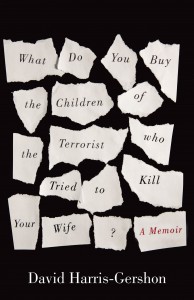 CAN YOU – MAY YOU – FICTIONALIZE all or parts of your memoir writing? Such a good question, and one I turn over this week to the talented hands of David Harris-Gershon, author of the brand new, astonishingly-titled memoir, What Do You Buy the Children of the Terrorist who Tried to Kill Your Wife? This is a question I field nearly every week in my classes, nearly every day from readers via email, and all the time in my own heart. In a first here on the Memoir Project blog, he’ll combine his writing lessons with his writing sample. I’m sure you’ll see why. Read on.
How to Get Away with Fictionalizing Parts of Your Memoir
by David Harris-Gershon
The topic of my memoir is absurdly serious, which presented a serious narrative problem: how to tell the story compellingly without making the narration melodramatic?
The answer was to fictionalize parts of the narrative. Allow me to explain:
In 2002, my wife was injured in a terrorist attack at Hebrew University in Jerusalem. After enduring an agonizing physical recovery, we returned to the States, where I – the secondary victim – became traumatized by PTSD-like symptoms which therapy failed to relieve.
And so, an emotional mess, I researched the attack as a way to overcome it, and in doing so found that the perpetrator had expressed remorse upon his capture by Israeli police. Learning this led me to seek the family of the perpetrator in East Jerusalem. Not out of revenge. Out of a desperate desire to heal.
Why do I mention all of this?
First, to demonstrate the serious nature of the story. Second, to reveal the context within which my fictionalization occurred. See, much of the narrative is about my internal suffering, about my neurotic (and sarcastic) brain’s attempt to survive under rather ridiculous circumstances.
And so, in order to both mitigate the melodramatic potential of my narrative and reveal the true nature of my overactive brain, I created fictional (sometimes humorous) dialogues throughout the book: dialogues with myself; dialogues with inanimate objects; dialogues with real characters that didn’t actually happen. Now, like a good memoirist, the key was to make sure the reader understood that such dialogues were fictional – that they were constructs.
Here’s an example from the beginning of the book, in which a doctor hands me a piece of shrapnel extracted from my wife’s body just after emergency surgery. The encounter happened. The dialogue did not:
With the doctor gone, I stared at the nut. It was all so absurd – as though a tragic comedy was playing out in which I had somehow secured a supporting role:
Doctor: Here you go.
Me: What’s this?
Doctor: Just a little something you might like, you know, to have, something to hold when you look back on these times we shared.
Me: You’ve got to be kidding.
Doctor: No, really. Sometimes people want these things.
Me: Why on earth would anyone want this?
Doctor: Oh, come on. You know you’ve wanted this all along, a tragedy, to know whether or not you’re strong enough to survive.
Me: Have not.
Doctor: Sure you have. It’s something you’ve wanted, a defining moment, and this nut is my gift to you, a physical reminder of the pain and grief you asked for, felt you always deserved, felt you’ve had coming to you after a quaint, two-parent upbringing devoid of poverty, sickness or death.
Me: I don’t want it, don’t want any of this.
Doctor: Whatever. Just take it. You’re one of us now. There’s no going back.
Me: I can go back.
Doctor: No, you can’t. And another thing: you’ll never throw it away. It will always be with you. Put it on a keychain or turn it into a necklace. You know, something meaningful, as a reminder.
Me: Fuck you.
Doctor: Bye now.
Now, the idea of creating something fantastical in memoir writing to express emotions or reveal truths in a more compelling way than can be done through simple explication is not novel. And such fictionalizing can be done in any number of ways: dream sequences, thoughts, hypothetical imaginings introduced by those magic words: I imagine that.
In my case, fictional dialogues were my vehicle – and they made for a ride that smoothed over the melodrama, allowing for dark humor to take its place.
Author’s bio
David Harris-Gershon is a blogger for Tikkun magazine, a Moth GRANDslam-winning storyteller, and a Jewish day school teacher. He received his MFA from the University of North Carolina, Wilmington, and has published work in numerous venues, including Colorado Review, the Pittsburgh Post-Gazette, and Passages North. His memoir – What Do You Buy the Children of the Terrorist Who Tried to Kill Your Wife? – is now out from Oneworld Publications.
AND THE WINNER IS…
I hope you enjoy Writing Lessons. Featuring well-published writers of our favorite genre, each installment of the series will take on one short topic that addresses how to write memoir, and will include a great big book giveaway.
It’s my way of saying thanks for coming by.
The contest for this book is now closed. Please see the next installment of Writing Lessons.
The winner of the book is eanlai Congratulations, eanlai! I’ll be in touch to send your book.
What I learned? They can keep anything they pull out of my husband in an operation! –djs
Ha! And offer it to you as a gift, of course.
I enjoyed this article about “fictionalizing” some of an “absurdly serious” (great phrase!) memoir. I loved the book cover. What an amazing way to tell of a life-altering tragic event.
I feel affirmed for “imagining” how my Mother and Father met, and for recreating the “therapeutic dialogue” during my psychiatrist’s visits at twenty-two, in a chapter called, “Vhat Are You ‘Sinking.”
Thanks so much, Charlotte.
Where is this “imagining” you mentioned? I’m intrigued.
David would have probably fared even worse without his sense of humor.
Trust me when I say that you are correct.
When I was suffering from some of my more severe symptoms, there were times when — without the escapism humor afforded — I could have descended much farther into the abyss than I did. Humor, or being able to view the world through an absurd lens, have a sort of psychological grace.
Yes! You’ve planted a seed about how I can move through parts of my experience. ‘Imagine that.’ Thank you.
You’re so welcome. The words “I imagine that” have been magical for me as a writer.
I read the lead-in a couple of times, making sure I didn’t miss something and wondering where the untruth officially started. I was thinking that the prelude to the imaginary dialogue would have been done with more intent. Something like,
“With the doctor gone, I stared at the nut. It was all so absurd – as though a tragic comedy was playing out in which I had somehow secured a supporting role. I was a mess. The doctor didn’t say these words, but I heard them…”
*I feel like I need a more obvious…”hey, here comes some stuff that didn’t happen” alarm. But maybe, that is the beauty of this style, that you can work in some untruths, and the reader trips over them mixing it all in with a dash of fiction.
Love the title of this memoir. LOVE.
Hey John,
First, glad you like the title. The book was originally titled “Shrapnel,” but we were forced to change it when another book of the same name came out. The title was actually the first line of my pitch to the publisher who ended up buying the book, and they liked it so much, they decided to run with it, despite the length.
As for your comment, I think this is a legitimate critique. For me, it works without hitting the reader over the head in such a way because the construct in the book has already been established. And even if it hadn’t, I think the reader would understand, given the content and dramatic structure, that this is a construct.
Certainly, this would become clear as the construct continues.
David Harris,
Thanks so much for a personal and speedy reply. I teach a memoir class and will use your words and promote your book tomorrow.
Cheers. If you have any other questions, or are curious about anything, please do ask.
Where do you teach?
St. Catherine’s School in Richmond, VA
Marion has been very kind to us. Last year she read student work and SKYPED her critique. Love to have you on board if you wish. Seniors!
I love this piece. The sense of humor, the willingness to create imaginary dialog that creats vulnerability by expressing your feelings at the moment. I think it takes a lot of courage to write this and put it out there for the world to read. The piece also gives me some ideas on places in my memoir-in-progress where I need to delve deeper. I must add your memoir to my must reads this fall.
Thank you so much,
Elizabeth
Thanks so much for your kind words, Elizabeth. The thought that this might help in your own writing is quite humbling.
David,
Love this idea. With each sentence it’s as if you’re building a bridge that leads to a clearer understanding of the truth. I’m curious if your imaginary dialogues are all darkly humorous in nature. Mine certainly are. In any case, I’m adding your book to my reading list.
Shalom,
Judith
Judith,
In the book, all the imaginary dialogues are darkly humorous or have some measure of sarcasm. This allowed the normative narrative voice to be more centered, to some extent.
There’s actually a long dialogue I have with two academic papers on the nature of reconciliation between waring nations. It’s long — so long the publisher wanted to cut it — but I love it dearly.
Thank you so much for the kind words. If you do get the book, please let me know what you thought.
Firstly, congratulations on a killer title. No wonder the publishers bought the book. It just goes to show the impact of a great first line (and title).
I am beginning my second memoir, having just completed my first, entitled Girl in Irish. This device of weaving in fiction is so useful as I embark on my second journey to the interior landscape. Such a unique way to create space for fiction in a memoir. It is always such a touchy subject for people and somehow this device you use broadens the scope not just for writers to examine their material but for readers to understand the essential place that fiction holds in memoir writing of any kind.
Simply put, memory is not exact and we have to fill in the gaps in creative ways to make of the story one that heals the writer as well as the reader.
Thank you.
I will be purchasing your book.
Congratulations again.
Actually, the title as it stands was the first line of my pitch to the publisher! My original title was “Shrapnel,” but we eventually changed it when another book of the same name came out. My publisher loved the pitch so much, they went with it despite the length.
And I agree with you that this device can be so useful, particularly when trying to weave in elements that memory sometimes might struggle to get a firm foothold upon.
Thanks for your very kind words. If you do get the book, please tell me what you think.
Love the intro to the fictionalized part , I stared at the nut. It was all so absurd – as though a tragic comedy was playing out in which I had somehow secured a supporting role: It sounds natural, like the way co-workers tell stories at the waer co ooler…….Thanks for the lesson, I’ll use it.
Thanks for the kind words, Patricia. So nice to hear you liked the way it was constructed.
What a compelling title! In an age where less is more and one, two and three-word titles are the rage, this is refreshing!
An interesting concept-to fictionalize the dialogue. It makes sense on a simple level-we can’t all expect to remember every single word uttered, especially in a crisis situation like David’s.
Thanks for the opportunity Marion and David. I’d love to read David’s story.
Thanks so much, Maureen. You’re right — in an age of short titles, I was shocked my publisher ran with it.
I’d love for you to read my story as well! *grin*
If you do, please tell me what you think.
I love the information and the humor.
Love this idea and have never seen it done, ” I created fictional (sometimes humorous) dialogues throughout the book: dialogues with myself; dialogues with inanimate objects; dialogues with real characters that didn’t actually happen.”
Hi Lynda,
I think a well-known memoir where this type of structure happens, and which was an influence, is Dave Eggers’ A Breathtaking Work of Staggering Genius.
oopps…I mean Patti…sorry.
PTSD: the gift that keeps on giving.
My husband and I have both been diagnosed with severe Post-Traumatic Stress Disorder. His was caused by combat when he was a young US Marine sniper fighting in Vietnam. Mine was caused by domestic wars that go all the way back to my earliest childhood memories. (My minister-father was diagnosed with multiple personality disorder and schizophrenia, and my undiagnosed mother could be even more terrifying than he was at times. And yes, I am writing a memoir about it.)
Lady, our rescued Cattle Dog, also has PTSD. We did not know this when we adopted her from the no-kill rescue people, but it soon became obvious. She definitely belongs with us.
Laughter is the best medicine we’ve found. This is why my husband and I say that we put the FUN in dysfunction!
I’m putting this as a disclaimer on my memoir: “My story is true to the best of my recall and understanding. Quotes are intended to capture the essence of a conversation and are not verbatim. Names and some identifying details are changed.”
That’s how I intend to handle the “but that’s not exactly what was said or precisely how it happened” naysayers. However, I really like your use of imaginary dialogue to convey true but unspoken feelings. Brilliant! I also love the title, it’s much better than any single word could be. I’ll have to read your book, now.
Lynda Lee
Hi Lynda,
Sorry to hear about the experiences you and your family have had with PTSD, and I thank you for the kind words.
I think that most people understand, when reading creative nonfiction, that dialogue is constructed as accurately as possible, but that nobody can remember them verbatim. Though I certainly understand the desire for a disclaimer.
This piece is so searing. And I absolutely understand the use of the fantastical and it comes across. I, though, took a different approach.
My two novels, Exclusive and Confidential Sources ( I like to think of them as the first offerings what may some day be “The Lost Tribe of Ronkonkoma” series, are based on real people (many relatives, including some revived from the dead) and some real events. But I also fictionalized and used my character’s fictional “alter egos,” meaning that I embellished some of their characteristics and life events. As a journalist for decades, I believe that if I make up more than a name or two (and I would only do that with a strong signal to readers) then I must call what I write fiction. And so these books are both labeled on their covers as “novels.” One of the first pages of Exclusive says “This book is based, casually, on our lives. Some of it is even true.” In Confidential Sources- the sequel- second sentence of dedication page says, “Again, these tales are less than true but not entirely false.” (books were published 2005, 2006 by Bantam Dell at Random House and are available on kindle)
My first book, narrative nonfiction, contained some elements of memoir, mine and others. “Muddy Cup: A Dominican Family Comes of Age in a New America,” (Scribner 1997). Expanded from a newspaper series that won the Livingston Award for International Reporting, it is all as true as I could make it to the very best of my ability. It is based on observation, history, corroborated interviews whenever possible etc. (and by the way it is used at a number of universities and colleges and will be- finally – available on kindle this Fall with an updated introduction, including a long passage from a character in the book who was 11 years old when I first interviewed him and is now a 39-year-old college professor).
First, I love the word ‘searing’ – thanks.
Second, thanks for sharing what sounds like some fantastic writing and books.
This helps me. I now feel free to write more on the tragic story of my grandmother’s death in 1937 at age 24. Due to circumstances, she was not treated very well by the doctors and nurses at the Catholic hospital where she was taken before she died. Thank you so much. – Linda
Hi Linda, I’m glad this technique will help you with what sounds like might be tragic imaginings. The unknown can still be written in nonfiction.