

Writing Lessons: Recalling Details When Writing Memoir, with Lila Q. Weaver
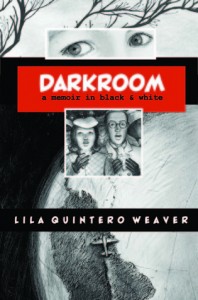 Having always wanted to feature a graphic memoir here on Writing Lessons, I knew I had the right writer when I read a review of Lila Quintero Weaver’s astonishing book, Darkroom, A Memoir in Black & White. A debut work, the book is about race and identity, as told through the story of her family’s emigration from Buenos Aires to Alabama in 1961. When I asked Lila about her topic for the how-to all Writing Lessons posts include, I was delighted that she wanted to explore how to more finely hone memory and get better at recalling details while writing memoir. Let’s see what she has to say.
How to Hone in on Memory When Writing Memoir
by Lila Quintero Weaver
Memory is the thing with feathers
Retrieving memories is akin to feeding wild birds. I stumbled on this association while working on my memoir.
Two tangled threads ran through my childhood as a Latina in 1960s Alabama: race and the immigrant experience. Some things I could never forget because society hasn’t forgotten them, like whites-only signs and segregated water fountains, still in place when my family arrived from Argentina in 1961. Some things I could never forget because they were personally explosive. At fourteen, when I befriended a black male teenager, I became the object of intense small-town gossip and carried the shame and indignation of it for years. There was no need to reconstruct memories that had never left me.
But I wanted to present a keener observation of the racism I witnessed. I needed nuanced stories and telling details that went beyond the scope of historians and journalists.
The problem with reconstructing the past is memory’s ephemeral nature, and the material for Darkroom had lain dormant for fifty years. So I began writing those memories within my grasp, no matter how spare and murky, all the while enhancing them through research. As a result of sustained attention, deeply buried memories started to resurface, often when my mind was on other things. I learned to keep a notepad handy. Once the phenomenon of retrieved memories kicked in, a metaphor helped me accelerate the process: bird-feeding.
The birdfeeder my husband built in our home basement will never make it to the pages of Better Homes & Gardens. It’s a 7-foot steel-rod post topped with a rectangular platform. There’s no roof. A wire-mesh inset keeps the birdseed from getting soggy.
For two weeks after he installed it, the feeder was a lonely sight. But then birds started coming, and I spent enchanted hours watching from my dining-room window, careful not to spook them by standing too close. I wasn’t surprised by the appearance of cardinals, who’d always been visible in our environment. But soon our visitors included birds that looked only vaguely familiar. When I consulted a birding guide, I discovered that brown thrashers had been in our backyard all along, scratching for grubs under the azaleas, camouflaged and unnoticed. Some birds struck me as exotic, but according to the birding guide, indigo buntings and rose-breasted grosbeaks were not strangers to our corner of Alabama. Why had I never seen them? The more I trained my eyes on the birdfeeder, the more astonished I was by the variety of species that passed through our backyard or even called it home. The feeder had lured them out of their hiding places.
Associating memory retrieval with the feeding of wild birds helped me adopt a patient, soft-focus approach, as if taking care not to spook memories darting nearby. As I continued writing, long-forgotten episodes drifted in with little additional effort on my part. Before I knew it, I’d recovered smaller, but powerful stories, like that of the African American school librarian that my principal asked white children to spy on, and the school play I didn’t invite my parents to attend because their foreign accents brought me unwanted attention. These episodes were locked in the recesses of my brain. All I had to do was build the platform of early drafts, and like shy birds, some colorful and exotic, others wrapped in camouflage, they came out of hiding.
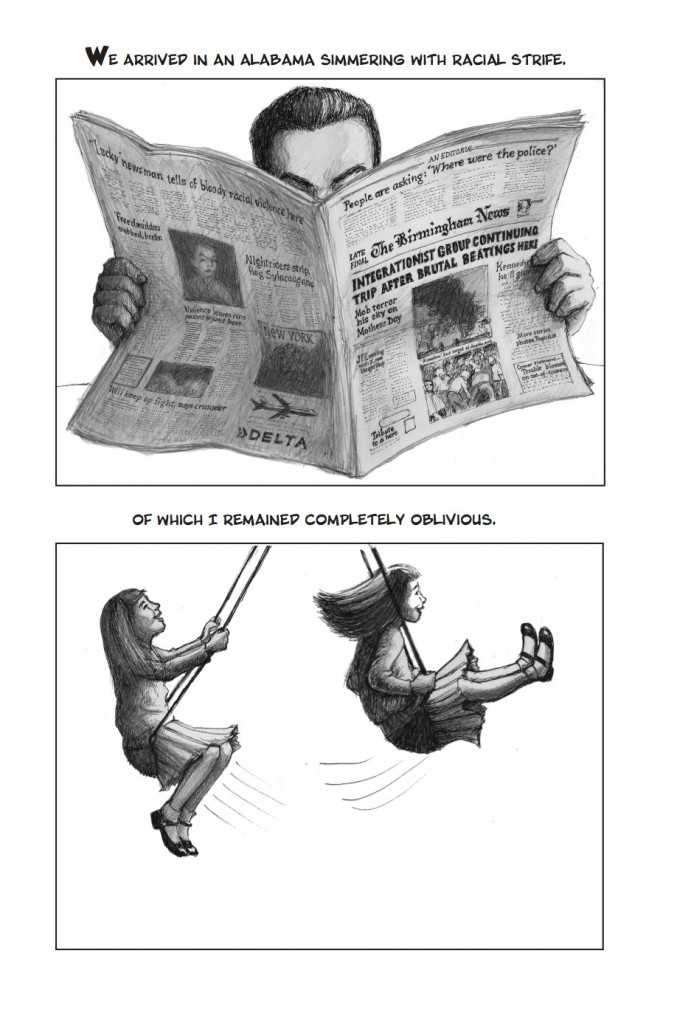
Darkroom, an excerpt
 Author bio
Lila Quintero Weaver was born in Buenos Aires, Argentina, in 1955. At age five, she immigrated to the U.S. with her family and spent her school years in a small Alabama town where she absorbed the material that makes up her illustrated memoir. She is a graduate of the University of Alabama. Darkroom: A Memoir in Black & White is her first major publication. Lila was named a finalist for the Small Press Expo 2012 Ignatz Award for Promising New Talent and for the 2012 Cybils Award in the Graphic Novels category. The Children’s Literature & Reading Special Interest Group of the International Reading Association awarded Darkroom with a Notable Books for a Global Society designation. She is represented by Adriana Dominguez at Full Circle Literary. You can read more about her on her website. You can purchase a copy of Darkroom, A Memoir in Black & White here.
AND THE WINNER IS…
I hope you enjoy Writing Lessons. Featuring well-published writers of our favorite genre, each installment of the series will take on one short topic that addresses how to write memoir, and will include a great big book giveaway.
It’s my way of saying thanks for coming by.
The contest for this book is now closed. Please see the next installment of Writing Lessons.
The winner of Lila Quintero Weaver’s fine book is Melinda. Congratulations, Melinda! I’ll be in touch to send your book.
I love the idea of memories as skittish birds that must be coaxed into the light. My experiences with writing family stories have been similar, and my frustration at not being able to ‘grab’ an entire memory has sometimes been very frustrating. I’ll try to keep the bird analogy in mind and let them appear at their own pace as I continue to cultivate a place for them to appear in my writing. Thank you Lila, and thank you so much Marion for these writing lessons. They are wonderful.
Kristin, thank you for feedback and for stating it so beautifully. It could’ve been another paragraph in my post!
Kristin, thank you! I’m sure Marion thanks you as well. Your response is beautifully worded. I have a feeling your story will be/is something to behold. Please keep sharing your wisdom on writing craft and let me know if my method of memory retrieval works for you. Best of luck!
The murky is where we live. There is some soggy bird seed in the feeder, but the birds will sort it out for themselves, showing you only what was useful for their task.
Patty, I agree. Murk is one reason that memoir writing is tough. Call it murk, call it ambiguity, the stuff that refuses to conform to an orderly narrative has to be patiently sorted out. Thank you for commenting and best of luck with your writing!
I like the idea of calling memory ephemeral. I do wonder about the fact that it’s also often unreliable. The dark moments tend to seem so much more shady (or colorful, depending on personal outlook), the bright moments so much more colorful (or dark again according to personality).
But allowing an open invitation for memories to come forward and spend time without any expectation does seem wise. Thank you both, Lila and Marion.
Eden, please see my response in the comments. I goofed by not using “reply.” :)
Eden, you offer wonderful insights. Thank you for commenting!
From what I gather, the unreliability of memory is a major topic of discussion in the study of memoir. One way to counteract that, I think, is to approach one’s recall with humility and to search out corroboration, when possible.
Of those two, I think humility is the best approach. Corroboration certainly helps, but one still needs to be able to admit s/he might be wrong.
It certainly is a good place to start….
Thanks again for pointing that out, Lila. Have a blessed day.
It was interesting to read your comments on writing your own memoir. I am currently in the process of dredging up old memories and experiences to write about them. They are so hard to recall without just “writing the story.” Yesterday, it struck me that I should begin to write what I remembered and wait quietly to see what else emerged, hoping that sitting with a memory would help bring detail to it and bring it to life. Thank you for confirming what I felt.
You are most welcome. You and I were synched in our discoveries. Best of luck with your memoir writing!
I could identify with Ms. Weaver’s insightful manner of describing the way she was able to recall episodes from her childhood that developed into “powerful stories.” I once watched many different birds feasting outside my kitchen window when I lived in a wooded area, and I marveled at the fact that so many others were missing out on such a wonderful show of nature. Yet I couldn’t stand too close to the window, lest I scare the birds away. I had to move away from that house about six years ago, and I have missed the birdfeeder ever since! I will remember it while sitting and making notes about my own memories, pulling on the threads of my memories, coaxing them forward as I build my own platform. Thank you, Ms. Weaver. If you ever write a how-to book on memoir writing, I will buy it!
Peggy, thank you for your affirming comments. We are both bird lovers, that’s for sure. As for writing a how-to on memoirs, no need: Marion’s already done it!
This is a great piece of inspiration that I’m sharing with the memoir-writing group I lead. It’s the idea that continuing to write, even when you think your memories are sparse, can draw out the concealed detail to a point that you’re able to capture much more of those memories than you thought possible. I love the wild bird seed analogy!
Jan, I’d love to hear more about your memoir group. Please e-mail me. And I’m glad to know my piece inspired you in some way. Best of luck with your personal writing and your work with the group!
I love the association between recalling memories and bird-feeding. So often I’ve talked myself out of writing what I do recall simply because of the frustration of not being able to remember the details. After reading this, I’m looking forward to patiently meeting the memories.
Yes! You just have to go forward and trust the process. Be prepared for some surprises. Thank you so much for commenting.
So often things I want to remember elude me – words, dates, and especially people’s names. The harder I concentrate, the less likely I am to remember. And, if I am responsible to introduce someone, it is a guaranteed time I will be totally blank on their name! I really like the analogy of a little bird, shy and easily scared away, flitting in and out of sight onto a birdfeeder.
I am a beginning, amateur memoire writer, in Jan’s group, and I have been amazed at the number of memories I have been able to write and remember as we add to our files. Thank you for this piece!
Hi, Nancy. You are welcome!
Believe me, I understand the battle with skittish memory. I could NEVER play Jeopardy. Even if I knew the answers, they wouldn’t come to me when I needed them. Patience is the key.
I was always asking my younger sister to remind me of this or that thing that happened to us as farm girls growing up. Thank you for giving me a vehicle to help jump start those memories for myself.
Good move, Doris. Although your sister is younger, she’s bound to remember details you failed to notice. I relied on my sisters’ memories to help me close gaps, particularly since they’re older by eleven and four years and certain key events happened before I was born.
YES! I feel like my memories are all the brown thrushes hiding under the azaleas (and someone needs to cut the dang grass so I can even see the bushes). Great analogy.
Kellie, I relate to the “dang grass.” I think we all do. Life is messy, right? The way I see it, part of our job as memoirists is clearing clutter to make room for a stronger narrative. Best of luck with your writing!
I enjoyed this so much! Like Jan in a previous comment, I lead a small writing group. Ours is at a senior center, and my elderly group members have such gorgeous stories to tell, but become frustrated with themselves when the specific details aren’t easily retrieved. I plan to implement this way of thinking in my own writing, and will encourage my older friends to do the same. I think it will really strike a chord with many of them, and allow them to be patient with the process and kind to themselves.
Thank you so much, Lila, for sharing your insights. (And, thank you, Marion for this wonderful website!)
Dear Melinda:
How lovely to meet you here. Many thanks for coming by. You are most welcome. I love providing a place to discuss my favorite genre. It’s such a gift to have writers of the caliber of Lila here, guest posting for Writing Lessons. I am deeply honored by them and by the presence of readers like you. Please come back soon for more.
Amen to that! It’s been a great privilege to enter the conversation. Thank you, Marion, for including me.
Melinda, how wonderful to learn about your group. I feel inspired. All my best to you and the dear people that participate.