

Writing Lessons: How to Write a Book Based on a Persuasive Sentence
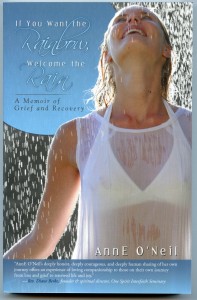 IT IS A PARTICULAR JOY when a former student of mine publishes a book. Such is the case with this week’s writer, AnnE O’Neill, whose marvelous memoir is celebrating its pub date this week. (And yes, that is the way she spells her name, with a capital E at the end). Titled If You Want the Rainbow, Welcome the Rain: A Memoir of Grief and Recovery, the book tackles a topic that brings many people to my classes. None of us will get out of this shared experience we call life without experiencing some grief. I am deeply honored that AnnE chose to share with you one of the issues we cover in my Master Class, which is how to write a book based on a persuasive sentence.
Write to the Beat
By AnnE O’Neill
When I began writing the memories, stories, and reflections that I intended to eventually transform into my memoir, how to structure these components into one coherent piece was incomprehensible to me. As I thought about it further, I realized one thing I was really grappling with was “what to leave in, what to leave out” as Bob Seger so aptly questioned in his song “Against the Wind”. My other challenge was to go deeply enough within the stories to make my point. Realizing this brought forth the real issue…”What is my point to writing this book?”
This question was answered when I was introduced to the notion that every successful memoir works from a premise to which they are trying to persuade their reader. That made sense to me. It also made sense to me that by articulating my premise and my experience within one topic sentence, the structure of the book would fall out from that. All I would need to do is to “write to the beat”. That meant each word (or phrase) in that sentence would become its own section or mini-storyline.
The topic sentence I developed as my beacon of light was “Grief gripped me until I opened to its depths, then to life.” Following this format allowed me to open the book with heartfelt exploration of the early losses in my life. I then shared how they “gripped me” as I held onto the pain and confusion the deaths of loved ones brought forth. The “until” beat offered the perfect opportunity to go into depth on that moment of transformation, of new perspective, new hope and possibility. I have heard that every memoir has to have that shift in order to make it worth reading, and I agree with that. The latter part of the book then expounded on and explored in depth that new perspective – from the early shaky moments of adapting to a new way of life through the amazing passion and joy available by having ventured deeply into inner work.
In my case, this structure also resulted in a straight chronological telling of my story – which I thought would be boring beyond belief. Instead what it offered was permission to pace the unfolding as it would best serve the storyline. I could spend a couple chapters developing backstory when needed. I could also inexplicably skip several years of my life when nothing during that time related to my premise. This pacing also lent itself nicely to appropriate character development, important since I had been told that an earlier version of my book did not have characters a reader would find interesting or likable. (“Ouch” since one is automatically a main character in their own memoir.)
The last benefit to working with a topic sentence for my book is it kept me on track. I no longer was in the question of whether something belonged in the book or not. If it supported my point, it went in; if it didn’t, it didn’t.
I had worked a long time and gone in a lot of circles before realizing that a topic sentence, first learned about in 6th grade English Composition, was the key to my dream of writing memoir. Once that was articulated, all I needed to do was remember my love of music and keep on the beat.
If You Want the Rainbow, Welcome the Rain: A Memoir of Grief and Recovery, two excerpts
I experienced grief after Brendan’s death like I never have before. With the earliest big losses in my life, that of Robbie and Mom, I had no space, no permission, no guidance to grieve. I was told to get on with life as completely and quickly as I could, both directly and indirectly in watching the other people around me.
At least with Dad’s death, I had enough space around the loss and the circumstances of my life that I could feel the sadness, the pain, and the emptiness that comes with grief. The emotions then were still alternately numbed and stoked by my ever present friend, alcohol. Besides that, my spiritual life was nonexistent, as was my inclination to really letting people know what was going on in the deep recesses of my heart and my mind.
I now lived my life very differently, and it was continuing to shift and expand more all the time. As I grew spiritually and emotionally, how I healed changed as well.
The first year after Brendan died I was in a bereavement group, started individual therapy with a grief counselor, continued in Interfaith seminary, sat in a Buddhist sangha, practiced Johrei, and read many books on grieving. I also created a photo / memory book of Brendan and wrote and held a one-year anniversary service. It took all of this – and good old Father Time – to heal.
Each of these things helped in their own way. The bereavement group offered the gift of camaraderie. It was in seminary I could be held. Through practice, sangha allowed me to rediscover the preciousness of life. It was through Johrei I realized what a blessing the whole journey of Brendan’s illness and death were in my life.
Excerpt 2:
Finally our day arrived, a mere five days after our decision to marry. A lot had been packed into those days, so it felt as though much more time had gone by. Brendan spent the night before our wedding at his parents since they were taking him to his intake sessions at Sloan-Kettering, the world-renowned cancer hospital, that very same day. It was my job to finish our wedding program and transform myself from harried, concerned partner to beautiful bride. As soon as Brendan and I saw each other for the first time that evening, I remember looking at him as he walked in the door, thinking “In about an hour, this man is going to be my husband.” Even after having been through a brutal, brutal day, upon seeing me he still greeted me with a smile, hug, kiss, and the statement I was the most beautiful bride he’d ever seen.
On the joyous occasion of our wedding, his day had been made horrific, not only by a long day at the hospital, but also by getting two pieces of very bad news. First he had found out he was going to have to have a feeding tube put in that upcoming Thursday. Even more troublesome, he had been told his cancer was more advanced than had been thought just five days ago. When he had called with this news earlier that day, I heard in his voice how disheartened he was. I also have to admit to taking a big gulp myself. Our initial thought had been we would have this unorthodox start to our life together but the odds were in our favor we would have a life together. This news foreshadowed what came to be – we’d have a life together but it would be far too brief. ….
The reception pretty much looked like that of a typical wedding. The meal was spectacular. Time was spent roaming from table to table, visiting with the guests. Toasts were offered, some touching, others funny. We danced to a funky version of “Have I Told You Lately That I Love You?” One of my friends noted if she ever had a man look at her like Brendan did me during that dance, she would be a very happy woman. And I was, albeit not one without worries.
Yet it was also obvious these were indeed atypical nuptials. The groom, rather than enjoying the feast, was served his own special order dinner of mashed potatoes and soup, which he didn’t even manage to finish. The bridal dance was also abbreviated as Brendan did not have the stamina to make it through the whole song. Fortunately, Joe and Vero had gotten up to dance, followed shortly by many of the other couples, so our exit to the table was not entirely conspicuous. Some silliness went on; the fabulous hat that was my find of the shopping excursion, got passed from me to my sister to her stepson to Brendan to Brendan’s father to other friends – with all of them posing for a photo in it. Much laughter was being shared, although Brendan was also grimacing from the pain each time he let out – or tried to suppress – a huge guffaw. Finally, the evening ended for Brendan just after nine, as he was completely exhausted from all the events of the day. He insisted I stay and visit a while longer, both to give the guests permission to enjoy themselves and to catch up with our out-of-town guests. I stayed for another hour-and-a-half. By that time, “my chauffeur,” Brendan’s father, had returned from getting Brendan settled in at our apartment, had loaded up the gifts, and was ready to call it an evening himself – as were most of the people since it was a work night. On my wedding night, I was home by eleven to snuggle with my husband. The snuggling was old, since it had always been a part of our nightly routine, but the husband was new.
As I lay in my husband’s emaciated arms that night, I thought of how blessed I was to be with this man, wherever our journey might take us. I thought about never before having felt as safe, physically and emotionally, as I did with Brendan. Nor had I felt as honored, respected, or heard. With him, I was blessed to know true unconditional love. It was both a great gift and subsequently a great loss.
Author’s bio
AnnE O’Neil, founder of your soul path, is an energy healer, Interfaith minister, and grief counselor. Her work is primarily with those who have experienced a significant loss in their life, supporting them through the healing to a place where they are once again excited by the possibilities of life. Her recently-published memoir, If You Want the Rain, Welcome the Rainbow: A Memoir of Grief and Recovery, recounts her journey with this process and looks at the damage we do when we dismiss and/or diminish our feelings of grief. She also teaches energy healing classes to help people learn to release heavy and foreign energy (such as that of grief) and to raise their own vibration. For more information, go to www.yoursoulpath.com.
AND THE WINNER IS…
I hope you enjoy Writing Lessons. Featuring well-published writers of our favorite genre, each installment of the series will take on one short topic that addresses how to write memoir, and will include a great big book giveaway.
It’s my way of saying thanks for coming by.
The contest for this book is now closed. Please see the next installment of Writing Lessons.
The winner of the book is Lew. Congratulations, Lew! I’ll be in touch to send your book.
Wonderful article!
I love AnnE’s explanation of how writing that one clear sentence which truly explains what the story is about acts like a beacon guiding the memoirist in not just structure, but also meaning.
It’s so nice to see the final results of AnnE’s hard work and heart-rending story efforts in print. Congratulations to both student and teacher!
– Carol
Carol –
Thanks for checking in and writing. I so loved sharing the journey of grappling with our sentences – and our whole memoirs – in Marion’s Master Class. Look forward to seeing you soon!
Blessings,
AnnE
Beautiful writing! So moving.
I too found AnnE’s description of the one key sentence so helpful. I am going to work on mine today.
I also offer congratulations to both teacher and student.
Well done.
Katherine
Katherine –
Glad this was helpful; it definitely had been when I first learned of it. Have patience with the process of coming up with that sentence, too; we all grapple a bit as we play with what works.
Good luck!
AnnE
I hadn’t thought to call it writing from once sentence until reading this from AnnE. But I’ve noticed a pattern throughout my life that fits into a topic sentence and I’d recently decided to write based on that.
Congratulations!
L’Tanya –
Isn’t it amazing how much our grade school teachers taught us?! Like I said, this was a key part of 6th grade composition, but I forgot about it for decades until Marion’s class reminded me how critical this is. Hope it helps your focus and structure as much as it did mine.
Good luck!
AnnE
This is full of insight…love the remark of hearing the music and following the beat. It all sounds so simple.
I’d love to read this memoir…my current WIP is about grief and loss. Somehow I feel this story is calling me to open up and live.
Thank you for the opportunity of winning a copy.
Write ON!
Rhonda –
Thank you for your comments – and good luck with your current piece and, more importantly, the steps towards “open up and live.” I find the deeper we are willing to go in the healing process, the brighter and more joyous the possibility on the other side. Between this writing and the energy healing work I do, I am very grateful for the life that has opened up before me. I am now creating the program to support others through this journey. Details to come very soon on my website.
Blessings galore,
AnnE
I am on the third rewrite of my memoir on healing from chemical sensitivity. I am not a writer by training, but I had some classes. I think of life as holistic, and structuring of scenes and stories seem to be linear, alas, we can only read one sentence at a time. I have had battles with my teacher about what to leave in or out (to me almost everything was relevant). So this focusing on that one premise, what is the point of the book, is quite helpful. I also resonate with the loss of a beloved, in my case it was a newborn 5 years prior to the chemical illness. That could be a book in itself…but related to the generation of illness. Thank you so much for this post.
Sue –
Glad this was helpful with the question of “what to leave in, what to leave out.” (I don’t know why I love that line from Bob Seger’s song so much; maybe it’s because it is relevant not only to writing but so much of life.) Whether or not it fits in this book, I would encourage you to reflect and write about how the loss of your child may have led to your chemical sensitivity. What I learned – and hopefully captured in my book – is that unhealed grief does impact us in a much larger way than we often think. After all, as you say, life is holistic.
Best of luck with the book and all that life brings you.
Much light,
AnnE
This post moved me to tears. It is so terrible and beautiful and intensely real that I could not read it all at once. I had to click back here three times before I was finally able to get through the whole thing without the screen becoming too blurry to see.
Thank you for sharing your journey through grief with us, AnnE. My heart goes out to you. Your memoir is now on my “must read” list.
As for the practical “how-to” advice contained in this post — THANKS, I really needed that! I have been wrestling for months with my “one-sentence summary.”
The first time someone asked me to describe my memoir-in-progress in one sentence, I thought they were kidding. My initial one-sentence book description could probably win a prize for the wordiest, most unwieldy, most ridiculously long run-on sentence ever written in the history of the English language.
And that was when I realized that I needed to break my story down into two memoir, at least..
Even so, describing my current WIP in just one sentence is a challenge. I have struggled long and hard, trying to perfect this one golden sentence. I’ve rewritten it hundreds of times. It’s become an obsession.
But it wasn’t until I read this post today that I finally understood the primary usefulness of this singular sentence. Until now, I had thought the one-sentence summary was to be used in pitching my book. Obviously, a good one-sentence synopsis can be useful as part of a well-honed pitch. But before I can pitch it, I need to write it. The idea of using my topic sentence during the writing process as a guideline for “what to leave in, what to leave out” had never occurred to me before. Brilliant!
Before today, I had pretty much settled on this as my descriptive sentence: “I was a traumatized 14-year-old in the days before Post-Traumatic Stress Disorder was known; when Schizophrenia was the default diagnosis, the prognosis was believed to be hopeless, and the “treatment” was to lock you up and throw away the key.” (I know, too wordy. But you should have seen my original sentence, which threw in the fact that my Vietnam Combat Veteran hubby also has PTSD — the topic I am now saving for my NEXT book.)
After reading this great article, I understand that my one-sentence-summary may be okay for pitching my book, but isn’t the topic sentence that *I* need to guide me as I write it. So now, my guide for what to leave in and what to leave out is this: “After my release from the asylum at age 16, I tried to forget my bizarre psychotic break — until a midlife divorce, precipitated by an appearance on the Oprah Show, sent me on a Madness Marathon in search of answers.”
Still too wordy…. but by golly I think this is going to help me get to the finish line with my memoir. I have been floundering with disjointed anecdotes from my life, unsure of how to weave them into one coherent narrative. Now I have a guide to show me the way.
Thanks, AnnE!
XOXO,
Lynda
Lynda –
Thanks for your heartfelt comments; they also brought tears to my eyes. The journeys of our lives are most definitely worth writing about. It makes it real, it allows us to be seen, it contributes to our healing, and it bashes through any shame that may be keeping us small. I am glad to hear you are gifting yourself with this process.
I am also happy you benefited so much from the notion of writing from a topic sentence. I have to say, this is just one of quite a few tips from Marion that helped me immensely. If you haven’t picked up her Memoirama book yet, I recommend you do. It is a small book and a quick read – but absolutely packed with helpful tips.
And play with the process of coming up with your topic sentence. You might want to put a bunch of key words on separate sheets of paper and re-arrange them to see what feels right.
Good luck!
Blessings,
AnnE
I’m eager to read AnnE’s book. The struggle I’m having with my memoir is that I have been assailed with different kinds of grief throughout my life ranging from raging conflicts with a father I wanted to love who died with issues unresolved, to the accidental death of one son, the suicide of another son, and emotional rejection of my wife soon after the suicide. So much of my story overlaps emotionally. I have tried unsuccessfully to write separate stories, but I can see from what AnnE has written that a chronological telling based on a persuasive sentence may be my solution. My thanks to you, Marion, and to AnnE.
Lew –
Wow! So sorry to hear of all the loss that life has dealt you to grapple with. From the little you’ve written here, I would encourage you to spend some time with what message it is that you are wanting this book to convey. Is it that grief comes in many different forms – some of it loss and some of it unfilled needs? Is it about ultimate resolution within oneself? Is it about lesson(s) learned during the process? I suspect that looking at these questions – and others of your own – about what you need to say will both allow a strong message to come forth and will help with your own healing and understanding around this all. I’m hoping this does not come across as unsolicited input: It is the type of input we gave each other in Marion’s Master Class…I guess except for the part of your own healing and understanding, which is my healing work and spiritual counseling coming through.
Blessings…and good luck,
AnnE
Thank you, AnnE, for the valuable information imparted. You’ve provided me with new tools to use as I continue writing my memoir.