

Writing Lessons: Finding the Message in Your Memoir Writing
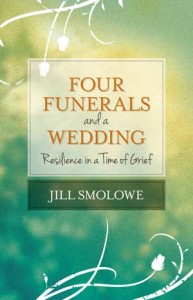 MUCH LIKE FINDING MEANING IN LIFE, finding the message in your memoir writing requires some digging. I would argue that in both life and in writing what you should dig past are the easy questions and their all-too-available answers. Meet Jill Smolowe, author of the marvelous new memoir, Four Funerals and a Wedding: Resilience in a Time of Grief (She Writes Press, 2014), and read about the questions she is always asked, as well as those she asks herself, when writing her books. To date, Jill is the author of two fine memoirs. Find out how she brought them to the page.
Finding the Message in Memoir
By Jill Smolowe
Twice I’ve written memoirs that involved painful periods in my life. The first, An Empty Lap, published in 1996, dealt with my husband’s and my long road to parenthood as we struggled to overcome a series of hurdles. My new memoir, Four Funerals and a Wedding, focuses on what kept me going as I cared for, then devastatingly lost four loved ones (my husband, sister, mother and mother-in-law) within a span of 17 months. After I completed each of these, the question I encountered most frequently was, “Did you find writing the book cathartic?”
I confess I find the question odd. For me, the memoir form has two valuable purposes. As a writer, it affords me the opportunity to reflect on an experience in a mindful manner that helps me to unearth meaning and extract lessons from a period of chaos. As a communicator, it enables me to share an experience through a focused narrative that aims to offer reassurance and insight to not only those who are going through similar turbulence, but their loved ones, who often feel uncertain what to say or how best to help. But before I can make the commitment to breaching my own privacy and spending considerable time revisiting a painful chapter in my life, I need clarity on two points: What is the lens through which I will tell my story? What is my message, the bit of hard-earned wisdom that I aim to share? For me, finding the answers to those questions requires detachment and emotional distance from the events.
As a result, I do not find the writing of a memoir cathartic. Nor do I approach the task with a hope or expectation that the process will heal me. Instead, what propels me is my belief that there is a book missing from the shelves—one that would have been helpful to me in my time of turmoil, one that I hope may now be of use to others.
That’s not to say that writing can’t be therapeutic. When I want to alleviate tension, stress or upset, I regurgitate my experiences into a journal. Raw and unfiltered, these entries provide an outlet to vent. Sometimes that act of writing helps to calm my roiling emotions. Sometimes the writing even serves, yes, a cathartic function. Later, those entries are invaluable, offering a snapshot of what I was thinking and feeling at a given moment, the surrounding details, snippets of dialogue—just the sort of material that helps bring a memoir scene to life. But is such undigested writing the business of memoir? To my mind, no. It’s not even the first draft.
Instead, by the time I arrive at a working plan for a memoir, I have gained sufficient distance to approach the writing with a clear eye and a measure of dispassion. Sure, emotions occasionally bubble to the surface as I recreate them on the page. Sometimes I bring myself to tears, tears that if I write the scene vividly enough, perhaps the reader will share.
But that is not my purpose. My purpose is to communicate my message. In Four Funerals, I aimed for readers to come away with an understanding of why the cultural script surrounding grief is limiting, misleading and often an impediment to healing. While writing, I kept my lens trained firmly on what exactly got me through so much illness, loss and grief. If an anecdote served my purpose, I used it. If not, I cut it, no matter how poignant.
For me, the work of memoir writing is selecting, culling, honing, shaping, rewriting. Rewriting. Ruthlessly chopping. Rewriting once more. The driver is my intellect, not my emotions. Catharsis? For that, my journal will have to suffice.
Four Funerals and a Wedding, an excerpt
Each day, I continued to draw solace from the appreciation my husband had expressed throughout his illness and then again shortly before his death. One day as I worked on my tribute for Joe, it occurred to me that too often such sentiments are saved for eulogies. I wanted the friends, relatives and colleagues whose kindness had particularly touched or steadied me over the last few years to know what I valued most about their support. Now. Before it was too late.
So, I began writing thank-you letters, not casual notes of acknowledgement, but heartfelt expressions of gratitude. I wanted—no, I needed—to give clear expression to what exactly it was about each person’s support that had lightened my load during the years of Joe’s illness and was continuing to buttress me in the wake of his death. At one level, this was a writing challenge that distracted me from painful thoughts of Joe. At a deeper level, it was an existential challenge that demanded I pay attention to the blessings in my life. Each time I uncorked my gratitude and let it flow, it helped me recognize the many reasons I had to go on without Joe.
I don’t remember the particulars of any given note, but I know one key thing I didn’t share with anyone because it didn’t occur to me until I was well into the writing of this book. As I revisited the gestures of kindness and particular types of support that had helped me, trying to identify ever more closely what had been most useful during Joe’s illness, I realized something that, once it presented itself, seemed both obvious and important.
In the days following Joe’s diagnosis, I had instinctively resolved not to be hemmed in by people’s concern and shut out from the rest of life. As a result, I’d gravitated to people who accepted that I didn’t want to talk about Joe’s illness and its toll. Month after month, as these friends continued to fill my mind with other ideas, I came to appreciate that they were providing something more than a respite from my static state of worry. All those walks and talks with the women in my writers’ group who kept me abreast of their writing frustrations were helping me to maintain a connection to the creative part of my life. The challenging stories my People editors assigned me, rather than trying to placate me with mindless busywork, were enabling me to continue functioning as a journalist. And the friends who, taking me at my word, pushed past resistant thoughts of “I don’t want to burden Jill with my problems” to talk about their financial strains, their less-than-perfect marriages, their parenting dilemmas—in short, their lives—were helping me not only to still feel like a valued friend, but to keep my own woes in perspective.
But it wasn’t until two years after Joe’s death that another dividend—the most important one—came into focus. New widowhood, I realized, would have been a lot more difficult and lonely if I’d emerged from the isolation of Joe’s protracted medical crisis to discover my other relationships had so atrophied that all that remained of my life were my memories of Joe. Instead, my life was still rich with engaging, caring relationships. Because there had been give and take all along, I was as familiar with the twists and turns of my friends’ lives as they were with mine. They were active and present in my life; I was active and present in theirs. Had my travails dominated conversation from Joe’s diagnosis to his death, perhaps that imbalance would have curbed people’s desire to spend time with me. (Jill is like a broken record.) Bred resentment. (She’s not the only one with problems.) Damaged intimacy. (Why would I turn to Jill? All we ever do is talk about her.) Even if the constant focus on me hadn’t felt narrowing or skewed to them, it would have to me, out of sync with the sorts of relationships I’d enjoyed prior to Joe’s illness. Instead, though circumstance had put a cloud over my head that none of us could ignore, my friendships had remained alive and vibrant. In some cases, they’d even deepened.
No, I didn’t have to reimagine my life. Save for Joe, the relationships that had always given my days texture and meaning were still intact and recognizable. I didn’t have to reimagine my life, I realized, because, thank God, I still had one.
Author’s bio
Jill Smolowe is the author of the new memoir Four Funerals and a Wedding: Resilience in a Time of Grief. To learn more, visit her at her website.
HOW TO WIN A COPY OF THE BOOK
I hope you enjoy Writing Lessons. Featuring well-published writers of our favorite genre, each weekly installment takes on one short topic addressing how to write memoir.
It’s my way of saying thanks for coming by.
Love the author featured above? Did you learn something in the how-to? Then you’ve got to read the book. And you can. I am giving away one copy, and all you have to do to win is leave a comment below about something you learned from the writing lesson or the excerpt. I’ll draw winners at random (using the tool at random dot org) after entries close at midnight Monday, April 14, right in time for the next installment of Writing Lessons.
Good luck!
what an excellent, concise description of the difference between writing for one’s own emotional reasons and writing to get a message across to others.
Thanks for you feedback, Lynne.
Excellent writing and analysis. I’m just starting to grasp that to write memoir, you do write about your experience, but it has to have a universal message. Grief and loss are certainly universal. I’m so sorry for your losses. So hard. Wish you all the best, Jill.
Thanks, Amy!
I admire the ability of my former colleague, Jill Smolowe, to acquire “sufficient distance to approach the writing with a clear eye and a measure of dispassion.” That, for me, is the hardest part. While I’m able to do that every day with news writing — the result of long years in the trenches — it’s the personal, often painful stuff that bogs me down, and I find myself wading as through mud in questions, regrets and introspections. What I need to do, though, is to follow Jill’s example of writing “raw and unfiltered” notes as an “outlet to vent,” and to heed Marion’s advice about pouring everything out into what she charmingly calls a “vomit draft,” as formless as it needs to be, and to cull it until only the gems (if such they are) remain.
Hey, Nick, it’s been a while. Good to hear from you.
Thanks for this beautifully written discourse on memoir and why and how you write this genre. For me, writing my memoir has been cathartic as my central message is a theme of child abuse in the form of emotional and verbal abuses and the ability to forgive as a 57-year old. In my writing, I have written letters to my now dead mother. As a child at the time of her abuses, I had no voice to fight off the words and the twisting of emotion. My letters to her have given my child self a voice to say what I would like her to know. It is my hope to share this ability to forgive much later in life those acts rendered against you five or more decades ago.
Enjoyed reading the excerpt for your most recent memoir. You have tackled a topic, grief, that so many hesitate to broach. Thanks for the courage and desire to share your insights and thoughts.
Thank you for featuring Jill’s work. I particularly enjoyed Jill’s explanation of writing to serve others and saving catharsis for venting in a journal. As an artist and a writer, I so appreciate the distinction. For some reason many suspect that art is catharsis, and sometimes this is true. But I find the best and most beautiful work serves a purpose far deeper than venting.
Jill, thank you for this excellent and practical post on writing memoir. Your points about connecting with your purpose for writing it, being clear on your message/themes, finding the takeaways, and knowing the difference between catharsis and takeaway for the reader resonate with my own experience of writing my memoir, now in it’s final editing stage after five years of excavating and shaping the memories and messages.
I’m hooked already! I’m desperate for more.
I admire the discipline you exhibit both in the essay and the excerpt, Jill. You understand what memoir should be at a deep level, and you hold yourself to that understanding. I wrote about grief also in my memoir but from a child’s perspective. I find it hard to fathom what you have experienced and the strength it took to both endure and to write. May the reception of this book bring you joy.
BTW: great titles for both books.
We all live with adversity of one kind or another. I so admire you, Jill, for staying in your life while the worst was happening. Too often we hide ourselves away in grief unable to stay connected to the rest of the world, leaving us totally isolated. I’m looking forward to reading your book, which sounds to me like a manual on living with whatever life throws our way. Thank you.
Aloha, Jill! And thank you so much for the reminder of focusing through a particular lens when we write memoir. Anecdotes abound–the stories that we are looking to share. And remembering the focus of the piece we’re writing helps us to view the stories/anecdotes through that lens.
I guess ALL of the stories (through all of the different lenses) can find homes–maybe they just need to be included in different memoirs.
And maybe that’s what makes sharing our stories such a rich experience.
Mahalo for that!
And thank you, Marion, for providing this space for another great writing lesson.
Such timing. I am just barely, just beginning to let myself acknowledge and really understand that there is indeed a ‘missing book’ — the one that I must write — and the work ahead of me seems so daunting. This post, and the excerpt, really show me that it is not only possible, but necessary to put down, clearly and with as little drama as possible, my story — not for myself, but for every other woman like me (and their husbands and families). I know there are such folks out there, but this has confirmed my fears and hopes, both. Thank you, Jill, for this most timely encouragement, and thank you, Marion, for always finding the very best memoir authors to share with your audience. Namaste!
Your comments are so thoughtful and so wonderfully supportive. Thank you. Truly.
jill
I enjoyed reading this abstract from Jill Smololowe’s memoir – a clear example of writing with a message.
I am not sure if the memoir I am writing is a “missing book.” The impetus for writing came after my breast cancer diagnosis and the resulting questioning of my life’s meaning and legacy I would leave for my children. I also realized then, how little I knew about my parents and grandparents, now all deceased. I feared that with my death, their stories and mine, would be lost to future generations, if I didn’t write it down. I didn’t set out to write a literary work of art. In fact, English is my second language, and I had just taken my first writing class – memoir writing.
Having acquired a tiny bit of knowledge, I am torn between what I had wanted to do – writing a story of my life and what I know about my parents and grandparents, versus what I now understand a good memoir to be. I also find it difficult to start with a message, or even a definitive answer to “what is this story about?” I end up dwelling on the message forever. I found it easier to first write a story that “wants to be written” – then think about what the message is and cutting out unrelated parts.
My first memoir story is of a Jewish girl, later a young woman, trying to fit in with the Soviet people and regime, intent on denigrating her and known for a long history of Jewish oppression – I know my experience is not unique. I suspect, nor is my message of not passively standing-by, even when ethnic intolerance happens in faraway lands, because such intolerance corrupts the souls of not only perpetrators, but victims and witnesses.
Should I look for another message?
Wow! I can’t wait to get my hands on Jill’s book. What a powerful reminder to edit, edit, edit and cull, cull, cull. I have been remiss in not pulling an anecdote because it was so juicy and fine. Hah! I shall be far more aware of considering the reader’s need and not mine.
Thank you, Marion, for another helpful installment. I just came over to catch up on the posts that I missed. Perfect timing for me.
I greatly admire Jill’s strength and ability to set emotion aside. She did it during her husband’s illness and it is evident in this excerpt also. It is too late for me to go back and be less emotional during my late husband’s illness, but I hope to be able to do so while writing my memoir.
Thank you both for the guidance.
Best Regards,
Patti
Recently I discovered your blog and book The Memoir Project. It is as though every post was written for me– very helpful and inspiring.
Today, this post really spoke to me. The timing is good in my place of re-writing (yet again) my memoir. Each time I revisit the draft, I realize how much work I need to do until it is ready for the public.
More importantly, the excerpt from Jill’s book clarified this–that my writing is not really cathartic–and I CAN dare to hope it is not just a form of self-indulgent self-therapy. (That’s my worst fear–along with those late night doubts–who will want to read this?)
Like Jill, I’ve always thought of myself as a communicator. I write to better understand where I am and who I am and how I got here–to make sense of the senseless in my life. Now I see how my life and experiences might have meaning for others.
And of course I can’t wait to read this book…!
Hello and welcome.
I am so glad that this post spoke to you.
Ah, the rewrite. Let me know if I can help.
And come back soon.
Best,
Marion