

Which Book Were You Meant to Write?
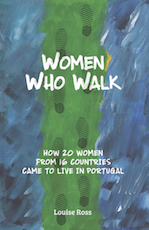 WHAT DO YOU DO WHEN you discover that you’re writing the wrong memoir? Well, if you are Louise Ross, you make the decision to write the right book. In this case, it was going from writing her own memoir to instead writing a collective one that includes the tales of the women she met in her ex-patriate journey. Ever had the feeling that what you are writing is not the right book? I think it happens to every writer at one time or another. If you’ve ever wanted to shelve one idea for another, please come along with Louise and find out how to make that decision. Here is a guest post from her featuring her newly-published book.
Shelving One Memoir Idea for Another
by Louise Ross
You’ve heard of the band Talking Heads, right? And maybe you know their song, “Once in Lifetime”? The first verse goes like this:
You may find yourself living in a shotgun shack
You may find yourself in another part of the world
You may find yourself behind the wheel of a large automobile
And you may ask yourself, “Well … how did I get here?”
That last line, “… how did I get here?” Do you sometimes ask yourself that? I do.
Because I’ve lived in four different countries since leaving Australia 35 years ago, I had the idea that writing my memoir would be a great way to answer that question. By way of formulating themes to explore, I wrote down a long list of questions to consider, including ‘how did I get here?’
I played around with assignments Marion, my memoir writing coach, had given me, and then at some point, I came back to her and said, “You know, I don’t think I have a book-length story to tell – maybe half a book, and then I’d have to make the rest up.”
So I shelved the personal memoir idea.
Five years ago, I moved to Portugal and joined the social organization International Women in Portugal (IWP) and soon after I started participating in an IWP weekly hike. On those walks, I was hearing captivating personal stories, the caliber of which caused me to take stock of just how exciting and stimulating it was to be mingling with a group of worldly, educated, well traveled and intrepid, multi-lingual women.
It occurred to me that writing a collection of memoirs would be far more interesting than writing my own. Also, I thought that by committing these stories to print this book would become an important addition to Portugal’s historical archives given that it would document the oral histories of a diverse sampling of women who, for a myriad of reasons, have found their way to this country from all corners of the globe at the end of the 20thand the beginning of the 21stcentury, and during a time of massive global changes. (Ironically, in the 15th century it was from this point that the great Portuguese seafarers set off in their caravel to discover the world, and now the world is discovering Portugal).
How I went about the project is simple. It started with an informal interview with a Swedish woman I met on the IWP weekly hike, followed by practice interviews with a couple more women I’d met. I recorded the interviews on my iPhone and when I transcribed them, I knew I had something, but in order to craft the content into something significant, I came back to the assignments Marion had given me, one of which was formulate themes to explore. After some thought, I decided to focus on these three questions:
- What compels someone to leave their country of origin?
- What happens to them on their journey to the new place?
- And what causes them to finally land somewhere and decide to stay, if not for the rest of their lives, then for an extended period?
Twenty-seven interviews later and three years into the project, I had about 450 pages, which I painstakingly edited down to 20 stories and 250 pages. What I noted when I edited and re-edited is that the women inadvertently answered the questions above while also revealing some additional topical themes particular to expatriates, such as the following:
- The experiences of Adult Third Culture Kids
- Feeling like an outsider in your own country
- Returning to one’s country of origin
- The question of where is home
- The trailing spouse experience
- Traveling as an outer expression of the inner journey or the Hero’s journey
I would not have thought to explore these themes when I began the project; simply, I did not have enough insight about the broader picture. It was my interviewees who informed me, introducing me to topics I wasn’t familiar with, such as ‘trailing spouse’, showing me that their stories were far richer and more complex than I had envisioned.
Since Women Who Walk launched in January 2019, it has been exciting to witness during readings, presentations and online discussions how the topical themes resonate for readers, both in the expatriate community in Portugal, and abroad, particularly in the U.S. where there is curiosity about Portugal, and interest in living abroad. This encouraged me to add book group discussion questions to an updated ‘Kindle Direct Publishing’ edition of Women Who Walk; readers seemed to need a vehicle to talk more about their own journeys or the journeys they hoped to embark upon.
I was in London just prior to International Women’s Day and I learned of WOW, Women of The World Festival. Its founder and director, an awe-inspiring creative by the name of Jude Kelly, former South Bank Center artistic director, had this to say:
“Women can do extraordinary things because they’re human. The difficulty is they’ve been made to feel that it’s an unusual thing, mainly because people have not called on them to be extraordinary and haven’t really wanted them to be extraordinary. But we are.”
She goes onto say, that we have a “mutual responsibility to value our own stories.”
Ultimately, I was motivated to realize this memoir project because of my personal conviction that the truth of women’s lives matter, and I’d like to think that by documenting the personal triumphs and disappointments, educational and professional achievements and failures, travels, adventures and discoveries, the decision to marry or not marry, the decision to have or not have children, Women Who Walk achieves Jude Kelly’s directive by valuing the female story.
Author bio: Louise Ross is Australian. She has lived in the UK, France and the United States. In 2014, she moved to Portugal. She lives on the Estoril coastline. See her on her website. Her new book is Women Who Walk, How 20 Women From 16 Countries Came to Live in Portugal.
HOW TO WIN A COPY OF THE BOOK
I hope you enjoy Writing Lessons. Featuring well-published writers of our favorite genre, each installment takes on one short topic addressing how to write memoir.
It’s my way of saying thanks for coming by.
Love the author featured above? Did you learn something? Then you’ve got to read the book. And you can. I am giving away one copy, and all you have to do to win is leave a comment below about something you learned from the writing lesson or the excerpt. I’ll draw winners at random (using the tool at random dot org) after entries close on April 30, 2019.
Good luck!
I am passionate about Portugal and walking because my husband and I plan to go to Portugal next year to walk the Camino de Santiago. Also, I have wondered if I really have a book length memoir inside me, but I definitely need to write. It’s nice to know that a shift in projects can be the ticket!!
Hi Becky,
Perhaps walking the camino will inspire you! Take a journal and jot down notes at the end of the day (hopefully you’ll still have the energy!) and who knows what might come to you, such as material for a memoir inspired by the daily ritual of walking a spiritual path – which is what the camino is all about.
Good luck!
Louise
Hi Louise,
Yes! We walked the Camino de Santiago in Spain last year (Camino Frances, the most popular route), and I journaled along the way. I think about that pilgrimage every single day. It has changed me in so many ways: my thoughts, my gratitude, my priorities, my plans for the future, my source of joy (Jesus!). My pilgrimage in Portugal will be a sweet continuation of the work that has already begun in me.
Lovely Becky! May your Portugal pilgrimage be equally as enriching and spiritually nourishing as your journey on the Camino in Spain.
All the best,
Louise
I really want to read this book. I was born and raised in the United States, but spent some time living in England in my twenties. Although it wasn’t as exotic as Portugal, it was still a great experience. There’s something wonderful about living in a foreign culture, where every aspect of daily living is different from what you are used to. I never felt so awake and aware as I was during my time in Great Britain, because I couldn’t just get by on autopilot for anything, not even grocery shopping.
I, too, am changing my focus as I write my memoir. Originally, I thought my story was about trauma and PTSD. Now, the focus is on learning, growing, and healing from trauma. It’s a welcome change!
Hi Linda Lee,
I think you’d love this book; all the women interviewed left their country of origin in their 20’s, like you, or left during their childhood with their families to live abroad. And all talk about that positive aspects of living in another culture, the way it broadens your horizons and causes you to feel very much awake and aware of the simply things, like grocery shopping!
And it sounds like the shift you’ve made with your writing is also going to be a positive one, for you and readers: the path of healing from trauma.
Al the best to you and good luck!
Louise
Wow so inspiring with a common theme so many relate to “fish out of water”. I could so relate to the short list regarding adult children, feeling like a stranger in your own country. Twelve years ago my husband’s job moved our family of 6 from a tony Southern California beach community to a modest Midwest town, and believe me when I say it equates to moving abroad. And my husband is French, so I keenly understand what being in a foreign country is. My memoir is an attempt to illustrate the search for reconciling the numerous losses and hidden blessings the move produced, how it shaped my understanding of “a good enough mother” and the struggle to know “what truly is home”. Thank you Marion and Ms. Ross, women truly “get” each other on so many levels, writing just one of the many platforms of the sisterhood.
Hi Jenny,
I hear you: feeling like a stranger in one’s own country can happen just by virtue of moving cities; and then moving states, well, that can feel like moving to a new country! And yes, the losses inherent in moving can be numerous, and the gains … just as numerous.
And when we move, not just once, but several times, the issue of ‘where is home’ looms large, particularly with each new move. You know, i have a meme on sticky note on my desktop which I love to ruminate over when I’m feeling a bit ‘lost’. It goes like this: “Home is not a place, it’s a feeling.”
Good luck with your memoir and all the best,
Louise