

How to Write Dialogue in Memoir: Don’t Linger
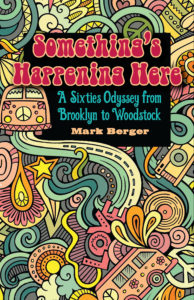 KNOWING HOW TO WRITE dialogue when writing memoir does not require a great memory, or that you were carrying a notebook beginning when you were eight. Nope. Knowing how to write dialogue requires knowing your here-to-there of the story. How far are you going? What is the arc of your tale? Once you know that, you can choose what moments along that arc need to go in and which need to stay out. And then you know what it is your characters said that must be reported in your text. To show you how to manage this, I’ve asked Mark Berger, author of the gorgeous and newly-published memoir, Something’s Happening Here, to explain.
How to Write Dialogue in Memoir: Don’t Linger
by Mark Berger
In the autumn of 2012, when I enrolled in Marion Roach Smith’s memoir class, “Writing What You Know,” little did I realize how the popularity of the class would create two requirements that helped me discover my voice as a writer.
We met on Wednesdays from 6 to 9 p.m. and usually there were twenty students. This was not one of those creative writing classes where the left brain tells the right brain that the old brain has to get the new brain out of the way. No time for that.
Marion’s stated goal was to have each of us read a new story each week. So, that piece I’d been rewriting for years, well, that was over and done with after the first session. Now, I had a weekly deadline and it worked wonders for my writing. Over three years, I wrote 43 stories.
Having a roomful of students, all primed to read, means their stories can’t be too long. Marion set a 750 word limit. Period. So I developed a system to achieve both goals: producing a new story for each class and limiting that story to 750 words.
Before I started a story I spent time thinking it through. Did it start here and end there? Was I this and became that? In a word, did it have an arc? Did it have something to say?
Next I wrote as much as I could without stopping—kneading facts and feelings into the draft until it became too stiff to continue. The next day was an off day. The ingredients were allowed to interact; the yeast allowed to rise.
Drafts after drafts followed, usually eight or more, until I was close, 1,000 words. Every word had to earn its place on the page. Nothing extraneous was allowed to stay. I learned to love contractions and to view “that” with suspicion. But the most important discovery I made had to do with employing dialogue.
Unlike exposition, dialogue can’t linger. Another character is waiting to put in their two cents. Since this was memoir, I had a clear idea of how each character would sound and what they would say. Monologues and soliloquys were out.
One week I had the perfect idea. I would write three stories, Pink, Turtleneck, and After, that were almost all dialogue. Each one would highlight a different lowlight of my bumpy marriage. While the stories are each less than 200 words, they succinctly conveyed the problems we were having.
I’m proud to say the stories I began in Marion Roach Smith’s class formed the basis of my memoir, Something’s Happening Here: A Sixties Odyssey from Brooklyn to Woodstock, published by SUNY Press/ Excelsior Edition. Pink leads off the third section.
PINK
an excerpt
“Like ’em?” Deena asks.
“They’re very pink,” I reply.
“Very, that’s why I love ’em.”
“What about the ones you have?”
“They’re not pink.”
“Other than that they’re fine?”
“But, they’re not pink.”
“How much?”
“I knew you’d ask?”
“I kind of did too.”
“I work, y’know.”
“Me too.”
“I put in my share.”
“I put in everything.”
“They’re not returnable. Sometimes a girl just needs to get herself something pretty.”
“Sometimes we have to pay the rent.”
“Working in an office stinks. I want to learn a craft.”
“Look, I’m almost finished with college, working just about full-time, but no complaints. After all that crap we went through in Tennessee—I was so down on myself, but no more. Let’s just get through this, OK?”
“All I do is get on the subway, go to work, come home, eat, sleep, get on the subway, go to work. Thought pink eyeglasses would make me happy, maybe make you smile.”
“If they could do that, I’d buy myself a pair.”
January 1968
Author bio: Mark Berger lived most of his life near Prospect Park in Brooklyn. He has driven a potato truck, been a real estate agent and worked as an elementary school teacher and guidance counselor. In 2012, he attended A Writing What you Know class taught by Marion, found his voice as a storyteller and discovered a memory trove of tales from his life in the 1960s that demanded to be told. Something’s Happening Here is his first book. He and his wife, composer Rain Worthington, live in upstate, New York. Mark can be reached on his website.
HOW TO WIN A COPY OF THE BOOK
I hope you enjoy Writing Lessons. Featuring well-published writers of our favorite genre, each installment takes on one short topic addressing how to write memoir.
It’s my way of saying thanks for coming by.
Love the author featured above? Did you learn something in the how-to? Then you’ve got to read the book. And you can. I am giving away one copy, and all you have to do to win is leave a comment below about something you learned from the writing lesson or the excerpt. I’ll draw winners at random (using the tool at random dot org) after entries close at midnight June 3, 2019. Unfortunately, only readers within the US domestic postal service can receive books.
Good luck!
Brilliant! I need to incorporate this into my writing. Thanks!
Susan,
Once your get the hang of it, you’ll start using it instead of exposition. People love hearing other people talk.
Mark
A touch of dialogue makes a situation real
Diane,
We all talk. We don’t stand around describing things, at least not to other people. If it works, the reader will feel like an invisible guest in someone’s life. Isn’t that part of the pleasure of reading.
Mark
Congratulations, Mark, on having your memoir published by SUNY Press and on the wonderful blurbs.
Dialogue intimidates me in the same way that fiction does. It’s more imaginative. Your excerpt beautifully captures how you can move the story forward without narration. Hitchcock could do the same thing with a camera by zeroing in on shots that portrayed the story without having to explain anything more to the audience.
Hi Alberta,
Since we spend a good portion of our lives talking with one another, I think writing dialogue may be less daunting than it seems. I aim to capture the simple ways people communicate deeper feelings. The more natural the pacing and the language, the more real dialogue seems. If you’re not a Elmore Leonard fan, I suggest you pick up any of his books to see how he moves the plot along while his characters are sitting at a table in a diner sipping coffee.
Mark
Riveting dialogue. Great title, too. I can’t even think of the title without the lyrics playing in my head: “There’s something happening here, what it is ain’t exactly clear…” Oh, yeah.
What did I learn from this how-to? I learned that I have to read this book. ;)
By the way, my husband was born in Brooklyn in 1949. At age 9, his family moved to Stat Island. He went to Nam as a Marine. It wasn’t a good time.
We live in New Mexico now. But not on a commune. :D
Linda Lee,
Thanks for the kind words.
My book is available from SUNY Press, Amazon, B&N, and wherever cool books are sold.
Let me know how you like the full memoir.
Peace,
Mark
What I learned: that every married couple at one time or another has said, “Let’s just get through this, ok?” I may not win a copy of the book, but I felt the connection between writer and reader. That’s the whole point.
Stacy,
I am glad my story touched you. As it is memoir, that’s the way it went down. This story woke me in the middle of the night and basically said, “Tell me.” And I have.
Mark
Thank you Mark. You’ve encouraged me to work on my dialogue. It really gets to the heart of things in a short essay.
Maggie,
Try it, I think you’ll like it.
Mark
Wait! No ‘he said/she said’?! :)
This sample illustrates the power of words and HOW so few words can make a BIG statement. Readers are smart and don’t need to be told HOW something was said, it’s so evident here:
“Sometimes we have to pay the rent.”
Nicely done!
~ What’s Your Story, USA
What’s your story, USA,
I agree with your comment that we should trust the reader to understand. We all talk, so we all know how some words sound together, like the words you quoted. “Sometimes we have to pay the rent.” or just prior quote, Deena says, “Sometimes a girl just needs to get herself something pretty.”
That’s the way it went down. There are no villains or angels here, it’s the two of us trying to make our way together.
I am a theater artist. Your dialogue scene made me think of playwright David Mamet’s short scenes. David Mamet’s scenes can take on any location or feeling depending on the character intentions.
I identified with your dialogue. I felt the tension. I naturally thought of it as a good acting scene for theater students. The scene can be played as it is written, or it can be over the top comedy. It would be fun to try it out with actors.
I will practice writing weekly dialogue stories limited at 750 words. Thank you for the good idea.
Naomi
You’re welcome to play with it and let me know how it goes. This piece was one of four in my book that are almost entirely dialogue. I hope you get a copy of my memoir, enjoy it, and see how these dialogues work in a theater setting.
Mark
Learning to be suspicious of “that”s was a great line! I often struggle with saying too much, more than I need to (see!). I would have added all this “scenery” to that dialogue, but damn, that was powerful with just those short sentences!
This book is definitely on my list now!
Hi BJ,
I am a believer in Elmore Leonard’s advice: Leave out the stuff readers skip. I think you’ll find my stories are action and dialogue driven with only descriptions only when needed. Why not take one of your stories and pare it down and see if it reads more easily and makes the point you want to make.
Mark
I enjoyed the dialogue from PINK so much. Tight and revealing. It inspired dialogue I went on to write in a current scene as I work on my memoir manuscript.
I look forward to reading your book.
Thanks!
Lorie,
Thanks for the kind words. My stories are action and dialogue driven, they are fun to read. I hope you enjoy my memoir.
Well, after just reading the first six pages of my true story adventure two days ago – for the first time – to my children’s book writer’s group, I came to a screeching halt.
(An editor had suggested I move the afterward’s back material to the front to give the reader context and I was testing it out).
But the group ( and I) had serious doubts about the wisdom of doing so. They felt I should “just get to the story”.
So, I learned about this post!
Since the group, I’d been feeling like “oh no, I have to start again… wtf!”.
Hopefully your blog will be an online source for additional insight.
Meantime, I’m searching for a local adult writer’s critique group up here in Amherst.
I hope my brief article helps.
This story comes almost midway in the memoir, so readers already know both characters and what they have been through.
But the argument they are having is universal and I think it could stand by itself if I removed the specificity of “Tennessee” and made it more general.
I like jumping right in, it engages the reader by getting them to figure out what’s going on.
Good luck with your book.
Many thanks Marion!