

How to Write Good Characterization in Memoir? Think Pooh
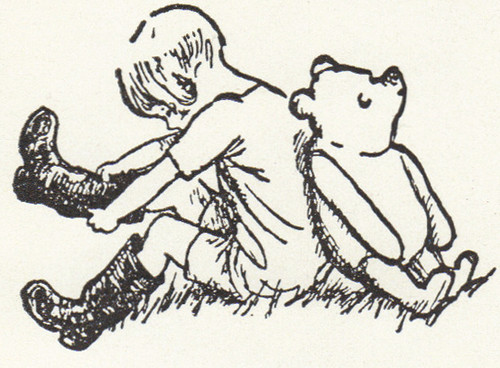 PEOPLE ARE ALL ABOUT telling you who you are. Well, kind of. These days, revelatory or confessional conversation is all the rage, of course, but much of it is peppered with shortcuts, with even the closest of friends offerings quotes like, “I’m an INTJ,” and then nodding reassuringly, like you are supposed to know them now, or “I’m a Type D, trending toward an A,” or some letter combo offered in lieu of real conversation. When on the receiving end of this type of talk, I always hope I look as amusedly disappointed as I feel. This is no way to communicate, of course, and though it is kind of funny, I suggest that when it comes to knowing how to write characterization in memoir, we all simply meet back at The Hundred Acre Wood.
Which Winnie The Pooh character are you? I have no idea, but I do know that we can all be sorted, identified and understood based on the characters from the very steady world in The Hundred Acre Wood, meaning that I know you will understand when I write of my family by stating that I am a Tigger, my sister is Kanga, my husband is Christopher Robin and that our daughter is Owl. Universal identifiers, these are also some of a writer’s best friends.
I’ve written about The Hundred Acre Wood before and how those characters are one of your best sources for characterizing the members of your family. Haven’t read Pooh? Think Peanuts or the Simpsons, or the characters in Greek mythology, and then use the character traits of those iconic personalities to help you fill in the people in your pieces and the role each plays.
What do I mean?
Maybe you have a complex negotiation scene in your current piece of memoir. How do you write good characterization? Well, perhaps your sister and you are trying to put your mother in an assisted care facility and no one is budging: You know it’s time; as ever, your sister is trying to placate your mother, and your mother doesn’t want to leave her home, despite the fact that she is too disabled to care for herself on her own. The piece is good. Your idea is sound and you know what it’s about. But you are hobbled by the real time aspects of living and writing it at the same time. Everything seems flat, especially the people in the tale.
Step back. Step out. Think Pooh.
Try sentences like, “Given a chance to placate, my sister will placate. Practically born in an apron, she is a provider: Good and kind, she would prefer to struggle forever with the niceties than to spend one moment in conflict. Me, I played pirates as a kid and I’m still always itching for a fight: Knife in my teeth, sword at my belt, I’m the one who gets the job done, and mostly we’ve balanced one another. Until now.”
They are not the best sentences I’ve ever written, but they’ll do for a first draft, and I got there by thinking less of the actual people and more about which iconic characters they represent. I find this method is particularly helpful when amid one of life’s big dramas, tempers are flaring and my senses are too inflamed to write much more than worthless accusations and the she said/she said of life. No one can follow along on your angry she said/she said tirades, believe me.
I was reminded of this recently as I was editing a manuscript as part of my coaching services. The book will have enormous power when the writer can write more universally and a little less from the point of her rage. In rage, she excludes us from fully understanding her characters. (And yes, I asked her permission to tell you this). So I advised her to read some Pooh. Goodness knows, we’ve all been given worse writing advice along the way.
Who are you? Leave me a comment below. And please do not give me an alphabet block I need to go look up. And do not limit yourself to the land of Pooh for your references. Who are you? Give me a phrase, a gesture, a universal reference of your own. Go on.
Need more help? Come see me in one of my online classes. The entry-level class, Memoirama, is a one-night, 90-minute class that is taught twice a month, every month but July and August. Follow that with Memoirama 2, and get yourself all set to enroll in the next session The Master Class. Can’t wait to hear about your work in one – or all – of these online memoir classes.
Oh, my, Marion. I think I’m Rabbit. :) Yours is a far more interesting way to explore characterizations in memoir. I’m going to look at some pieces I’ve written lately about family and use the Pooh technique. Bet that will give me some even clearer insights.
Hi there, Judith.
Rabbit it is.
Good luck with the device.
I find it frees me up to look at ,myself and others as characters, thereby giving me distance to write.
Let me know how it goes.
Best,
Marion
What a terrific bit of insight! I can’t wait to work with this idea. I think I felt the light bulb actually turn on!
Hi, Melinda.
I am so glad it helped.
Sometimes it’s the little stuff, yes?
Please come back soon for more.
Oh I’m definitely Rabbit! You know, “A place for everything and everything in it’s place”, and “It’s not on the schedule!” I love this way if thinking of your characters and fleshing them out instead of putting them in some box!
Dear Deborah,
Many thanks.
Yes, look how well Rabbit is understood, even from the distance of adulthood.
Those characters are cleanly defined, as ours need to be when we write memoir.
Write well.
Best,
Marion
Thank you for this technique. I’ll have to revisit Pooh and my notes on family. I feel curious about them with new energy.
Dear Melissa,
I’m so glad.
Use it well.
Best,
Marion
I’m Pooh–a big overweight and always up for a sweet bite. I’m sometimes accidentally wise and occasionally funny and I am a always a very loyal friend.
Dear Nancy,
You understand exactly.
Now write yourself with this new perspective.
Best,
Marion
It is too many years ago that I would have been able to answer quickly. My kids are closing in on being senior citizens – and my first book will be out in April. How old am I? Ageless and going strong.
But I do love your idea and will put it to work in the memoir that’s half written.
Thanks.
From a blog post I wrote in 2009:
For a writing assignment (home schooling)… I asked my kids to write a paper comparing and contrasting themselves with some well-known person, real or make-believe. To get them started, I gave an impromptu comparison and contrast of myself with Mary Poppins.
Mary Poppins is practically perfect in every way, whereas I am not remotely perfect in any way.
Mary Poppins cleans up messes with a snap of her fingers, while I generate messes with no effort at all.
Like Mary Poppins, I love to laugh!
Unlike Mary Poppins, who appears stern but is actually loads of fun, I am perceived as being frivolous and fun-loving, even though deep down I am actually very serious.
Mary Poppins was never without her handy umbrella, but I never think to carry an umbrella, even during rainy season.
According to the book, Mary Poppins “…never told anyone anything.” I, on the other hand, tell everyone everything. (I have no secrets.)
And lastly, Mary Poppins stayed and worked contentedly in a place as long as she was needed, and then moved on when the wind shifted. Likewise, I like to see myself as content in a place only until the “wind” of the Holy Spirit moves me on.
Another nugget to put directly to work from the font of all memoir knowledge. Thanks for this, a skill which will make its way into the current edit of my MS post haste!
Oh Marion, you have done it again with a sneak appearance in my In box at just the right moment. I am sitting to write a personal essay about my dad and the small kindnesses that define our familial bonds as I visit him to help him through a surgery. He is definitely a cross between Eeyore and Pooh. He is somewhat slow and prodding but once he has fulfilled his duty and pointed out obvious obstacles, he then liberates himself to let a few rays of optimism in. I, then happily proceed in best Piglet fashion.
Happy New Year Marion! Here is to a productive and joyful 2020. Thank you for your wise guidance.
Cheers,
Jaime
I am a shark, but not the scary antagonists portrayed in movies. Sharks need to constantly move forward so that water filters through their gills. That’s me. Swim or die.
I move like a shark myself, though I’ve never thought of it before.
Thank you for this.
I think all of this helps all of us to see ourselves as characters we can define.
Best,
Marion
My mother has a personality theory based on Sesame Street: you are either predominantly a Bert or an Ernie, though you may have some characteristics of the other. It works! (I’m a pretty solid Bert, as was my father. My mother and brother are Ernies, and my husband is mostly Ernie.)
Ha ha ha.
Yes, indeed.
Look at this.
Thank you.
Best,
Marion
Wonderful technique–thank you, Marion–opens up new ways to see oneself, one’s family, one’s “characters.”
I am the elder brother of the Biblical prodigal son, Austen’s Elinor (sense) rather than Marianne (sensibility), mostly Alcott’s Jo (thinker, writer) with a little bit of Amy (lover of beauty) thrown in, and a mixture of Friends’ Ross (intellectual, overly earnest) and Monica (control freak).
I love the idea of thinking about the characters in Friends, Marianna!
I adore this.
It’s perfection.
Thank you.
My memoir is prescriptive, and way more brief than some, at this point. I’m 16 chapters in, but I’ve been nursing it, then leaving it (as I’m living it as well, and I’ve often heard it’s best to journal while you live through a situation, and write about it when it’s in the rear view mirror. The journaling serves as our bread crumb trail to give us the keys to re-opening the story when we are finished emotionally processing it — or at least well into being through many of the emotions).
I’ve seen the wisdom in this thinking since my memoir is on motherhood and involves some situations with one of my children who is just entering young adulthood. I need to give him the space to become more of who he will be before these stories (as graciously and gently as I tell them) can be put out there. They are my stories, but he is in them, and because of that, I need to consider him thoroughly. All that to say, while I write, I read your advice regularly.
Every time a new way of looking at character comes forward, it is like when we go to the gym (those of us who do) and we try a new class or a new machine. We are stretched and worked in a way that wasn’t usual to us. The benefits of this can’t be emphasized enough. I’m so eager to go think about who we all are in terms of characters in many places – Star Wars? The Hobbit? Pooh, of course. What about Alice in Wonderland? Some families have many of those types of people in them too – Mad Queens and Madder Hatters.
As for myself, I am like Anne of Green Gables – very much myself, curious, giving, sometimes more forthright than I ought to be, and loyal to the end. I love deeply and wonder at the variegated beauty in people and nature. I could be a bit like Jo in Little Women as well – another fiery girl who gives everything for her family, lives to create, knows her own mind, and yet needs to learn to lean on others more than she does.
Thanks for this beautiful question and your continual faithfulness to lead writers toward excellence.
You are most welcome, Patty.
Many thanks for your generous comment here.
We learn from one another.
It’s wondrous.
Best,
Marion
I was thinking that I was more like Lucy from Peanuts than any of the Pooh characters, but as I read more about the characters in Pooh, remembering who they are, I think at this point in my life, I’m more like Kanga. I think we can change over time, over our lives, from one character to another.