

On Balancing Curiosity, Research and Writing with Matti Friedman
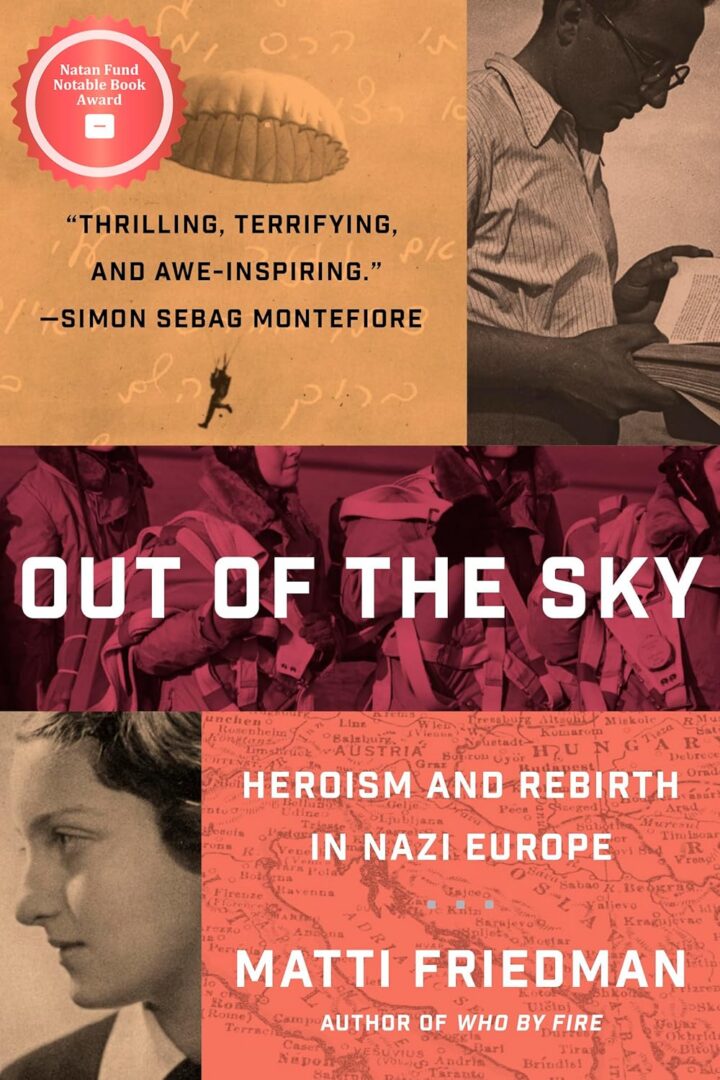
MATTI FRIEDMAN IS AN award-winning journalist and author. His work as a reporter has taken him from Israel to Lebanon, Morocco, Moscow, the Caucasus and Washington, D.C. A former Associated Press correspondent, his work has appeared in The New York Times, Smithsonian Magazine, The Atlantic, and elsewhere. He currently writes from Israel for The Free Press. The author of five nonfiction books that have been translated into a dozen languages and have so far been awarded the Sammy Rohrer Prize, the Natan Prize, the ALA Sophie Brody Medal, and more, his new book is Out of the Sky, Heroism and Rebirth in Nazi Europe, just out from Spiegel & Grau. Listen in and read along as we discuss balancing curiosity, research and writing and a whole lot more.
Powered by RedCircle
Marion: Welcome, Matti.
Matti: Thanks so much for having me.
Marion: Well, it’s an honor to meet you. Your work as a reporter has taken you from Israel to Lebanon, Moscow. I talked about that in the intro, the Caucasus and Washington, D.C. You were born in Toronto. You currently live and write from Israel. But I want to get back to the start of you. Give me a picture of the young Maddie. Are you in a library? Are you poring over maps? Are you reading spy stories? I worked at The New York Times. My parents, my sister, my husband, everybody’s a journalist in my life. And I’ve known a great many foreign correspondents and they’re not all the same, but they are all lit by something that propels them to do the remarkable work to bring us the truth about the world.
So talk to me about the young you and what lit this correspondent.
Matti: It’s hard to remember, but as it happens, I was just having a flashback from my childhood because just before we started this conversation, I was reading a bedtime story to my nine-year-old, who’s my fourth child. Kid and I was reading him The Hobbit. We just finished it actually this evening, and I had this flash of me around the same age hearing. This book read to me by my dad. And I think that The Hobbit kind of taught me.
Something that has always stayed with me, which is that, you know, at some point you’re supposed to leave your safe and pleasant surroundings and you’re supposed to head off on some great adventure and all kinds of things will happen to you. Some of them will be great and some of them will be awful and you’ll return with a fantastic story. And I think that was programmed into my brain at a very young age and on a subconscious level kind of dictated what I ended up doing later on as a journalist, you know, leaving the safe and pleasant confines of suburban Toronto and ending up in the Middle East, writing about all kinds of things, some of them pleasant and some of them less so.
Marion: It’s a great answer. And as you said that, I pictured myself on the couch reading The Hobbit at, oh, probably 13, and thinking many of those same thoughts about how far can we go, how dangerous will it be, how satisfying will it be. That book lit a lot of people, didn’t it? That’s a great answer. And I love, of course, the fact that it’s a book, which is… one of the reasons we write them, because they send other people off on those journeys, isn’t it?
Matti: Absolutely.
Marion: Yeah, absolutely. So let’s talk about creating or writing life. Your previous books include the 2022 book, Who By Fire, Leonard Cohen in the Sinai, depicting when the singer traveled from his home on the Greek island of Hydra to the chaos and bloodshed of the Sinai desert. And there’s the 2019 Spies of No Country, Secret Lives at the Birth of Israel, the Tale of Israel’s first spies, the 2016 Pumpkinflowers, A Soldier’s Story of a Forgotten War, which is part memoir, part reportage, part military history, and The Aleppo Codex, an investigation into the strange fate of an ancient Bible manuscript. And there’s, of course, a geographical line through here, but I’m interested in the writer, my audience’s writers. So what’s the through line for you?
We’re going to talk about your new book in a second, but what do you feel is what goes from subject to subject for you?
Matti: I’m looking for stories that seem small, but say something big. So the histories that I write are very micro in their scope. I’m not writing vast histories of the Middle East or of Israel, and I’m not writing about wars that everyone knows about. I’m looking for very small human stories that might seem at first glance to be marginal or obscure or even irrelevant, but say something big about Israel, which is the story that I cover, or about the human condition. So, you know, each of those books in its own way tries to do that. The story of Leonard Cohen, for example — we were talking about The Hobbit earlier. So Leonard Cohen is this guy living on a Greek island and he’s a singer and he heads off on a great adventure.
And the great adventure ends up saying something about art and about war and about the meeting of an artist in war. And it says something about Israel in the 70s and where Israel is now. So I try to pack a lot into relatively short non-fiction books about one or two or three or four individuals.
Marion: It’s a lovely answer. I’m a great believer of I’ve written a lot of essays. I’m a great believer of illuminating life’s big stuff by going into the small moments. And I think it’s a wonderful way to look at life. And let’s stick with Leonard Cohen for a minute, because I come from a sisterhood of Leonard Cohen worshipers. So, I mean, my sister and I dancing in the kitchen to Leonard Cohen is really seared into my mind.
And you gained access to previously unpublished writing and original reporting. to give us a picture of both a formative moment for a young country at war and a singer who at 39 was famous but unhappy and chooses to do something fairly colossal when he goes on a concert tour to the front lines of the Yom Kippur War. So let’s just dig a bit further into that small to big.
What was the small there? He’s a pretty big… famous person. Is it his ambition? Is it him feeling that he’s at a dead end? What’s the small to big there in that story?
Matti: So he’s one of the great rock poets of the 60s. And by the time this war breaks out in Israel in 1973, the Yom Kippur War, he’s famous. He’s written “Suzanne” and “So Long Marianne'” and “That’s No Way to Say Goodbye.” He’s got a string of really, really important songs that are still sung Probably those are the ones you were dancing to in your kitchen when you were with your sister. But he feels like he’s hit a wall. And this is at a time when you were supposed to, you weren’t supposed to trust anyone over 30 and he’s 39. And all the great rockers of the day were dying at 27, you know, that Jimi Hendrix and Janis Joplin and Jim Morrison. And so this guy is, he’s a senior citizen and he’s not sure he has anything. anything left to say, and he’s just had a child, his first child, so he’s a father for the first time, and he’s on this Greek island called Hydra, and he’s desperately unhappy, and then a war breaks out.
And he decides that he has to go there for reasons that are not quite clear, and I try to explore them in the book, and he ends up really rattling himself and really shaking himself out of his stupor And when he comes back from this war, he writes what ends up being one of his greatest albums, which is called New Skin for the Old Ceremony. So I think the book is about the meeting of art and real life or the meeting of poetry and war and the way one feeds the other. And you can’t really be a poet if you’re just… playing it safe and staying on your island, just like Bilbo Baggins. I can’t believe how much we’re talking about The Hobbit here, but, you know, Bilbo had to set out on a great adventure or he wouldn’t have been him. So you have to be in the real world in order to create anything that’s worthwhile.
And I think that that’s true for Leonard Cohen. I think it’s true for me as well and probably for, you know, for any writer.
Marion: I think it is true for any writer. I think even if you’re Emily Dickinson, who people like to refer to as, you know, staying at home and all of these things, what they forget is that she was at the center of so much intellectual thought at the time. She becomes our second greatest Civil War poet. And she could do it from where she was because everybody came to her, her next door neighbors, entertained guests. constantly, the Transcendentalists were there constantly. So she was there in that way.
So I agree. I agree. You have to put yourself in it to write about it. And that’s a lovely, lovely portrayal. The book is beautiful. Your new book is Out of the Sky, Heroism and Rebirth in Nazi Europe. And as far as this reader is concerned, it’s so very timely. We could use some courage stories right now, since we seem to be a bit divided, at least in this country, about what exactly is heroic, what who is courageous, and what the end game of courage should be.
So let’s set this up for the listeners. In 1944, a team of young women and men who had escaped the Holocaust made a choice that elicits from us a stunned sense of inquiry when they parachute back into Nazi-occupied Europe under the cover of a British military operation. Some of their names would become legendary. One of them is Hannah Senesh, who has an Israeli kibbutz named for her, as well as a forest kibbutz and 32 Streets. You make a point in your lovely opener of this beautiful book that her name appears as does that of Lafayette Street in Washington Square Park in New York’s downtown. She’s also credited with the lyrics for a beloved song, “Eli, Eli.” So if we may, and while there are many memorable characters in this really wonderful book, let’s start with her. How and when did Hannah become more than a street or a forest or a lyricist for you?
Matti: So If you have any kind of Jewish education, you’ve heard the name Hannah Senesh. She’s kind of like George Washington, maybe Davy Crockett or something like that. You know, kind of a caricature of someone from American history.
You’re not that interested in it. It’s a two-dimensional, you know, ideological caricature and it doesn’t really invite further inquiry. And everyone knows, certainly in Israel, this song, which is called “Eli Eli.” It’s a very short song in Hebrew, beautiful melody. It’s one of the most famous, if not the most famous song in modern Hebrew. And it was written by this very young woman named Hannah Senesh. But beyond that, I didn’t know much about her. And when I started writing this book, I was amazed to find what a complex and intelligent and brave character she was. She was a very young woman. I mean, she was 22 when she embarks on this mission, which is a British mission in 1944. into occupied Europe. She’s dropped from a British bomber into occupied Yugoslavia and along with a group of other volunteers.
And I tracked her and her comrades through this terrible year of 1944. And I did it using documents that I found in archives here in Israel and some memoirs that were published in the 40s and 50s. And I tried to recreate the world of these people, both to understand a moment in the mythology of Israel and of Zionism, but also to try to understand heroism. Because as you mentioned, we seem to lack it these days. I mean, it’s hard to think who our heroes are, really. I mean, we used to have heroes, people who you were supposed to look up to and want to emulate. And now I think our tendency is really to look at a hero and try to tear them down and try to explain to ourselves why this person is not really heroic. And I’m returning to an earlier time when people were capable of looking at these people and saying, wow, you know, that person deserves to be in a statue or in a painting.
So it’s an interesting exploration, or it was for me, of heroic characters who are very conscious of themselves as literary figures. And there’s an interesting connection between heroism and literature because the first subject or one of the first subjects of literature is heroism. I mean, almost immediately at the birth of Western literature, we have heroes. We have Achilles and we have Odysseus and we have Moses and David. And you can’t have literature without heroism. And I think it’s possible that you can’t have heroism without literature. So there’s some connection, which I haven’t entirely put my finger on between the demise of heroism and the… fading of literature in our society. There’s some connection there that I’m trying to explore in the story of these heroes.
Marion: We’re so grateful for it. I mean, we’re living in a country in the United States right now where we’re taking books about heroes off of the shelves. Heroes that come from all parts of our culture. And we’re fighting against that as much as we can. But I found this book just stepped right into that slot. that I need now to limb for myself, to define for myself what I consider to be heroic. And I think that’s a gorgeous concept about the connection of heroism and literature. And it gives me a great deal to think about. And I think everybody too, listening, will think about that. As we take those books away, what exactly are we trying to do with our definition of heroism?
It’s fascinating.
Matti: I think to be a hero, you have to have a story in your head. You have to have a very powerful story that explains to you what you’re doing and also reassures you that your heroism will be remembered. So you need a kind of historical consciousness in order to be a hero. And if you have no historical consciousness, so if all you know is what happened on the internet this morning, then you’re unlikely to embark on a heroic adventure. You need this idea that there’s a long story and you… Play a part in that story and one day, if you are sufficiently heroic, you know your actions will be retold. And in a story. And that’s a very kind of old-fashioned idea at this point. But I think that we could, you know, our societies, and it’s true here in Israel, too, our societies would would benefit from more historical consciousness. People need to think not only about how their actions will be.
Remembered in five minutes, but how their actions will be remembered in a hundred years or how their actions will be thought of by their children or grandchildren. It changes the way you act and think in a way that I think is positive. And in order to kind of engender that way of thinking, you really need to read books. You need to have an idea of stories and you need to think that they’re really important.
Marion: I agree. I think that it’s formative. And this is why literature can be considered by some people to be dangerous and by the rest of us to be the magic carpet that we need to climb on and look at the world with. So writing nonfiction books is a combo skill of reporting and writing, of course, and every time out the assignment is strewn with potholes. The first being that research, getting access, absolutely discerning the truth, keeping the interest and energy, your interest in energy up first, because you’re the one doing the digging.
But perhaps the one that is most seductive is the fact that no story really has an endpoint. So how do you apportion your time when researching and writing so that you simply do not stay in the research mode forever?
Matti: That is a great question. It’s a challenge that I find myself facing all the time as someone who does these books, which involve a lot of historical research. And one thing that happens every time you dive into a topic is you realize that you could just do this forever. There’s no… You could research a book for one year, you could research it for five years, you could research it for 10 years, and there are people who get lost in these research projects and never emerge. And I think the solution for me was one that I learned being a journalist. So I got my, I kind of underwent my journalistic bootcamp at the AP, the Associated Press, which is the big American news agency. And if you work for a news agency, I mean, the deadline is everything. You have to file by deadline. If your article is good, great. If it’s not good, doesn’t matter.
It has to be in by the deadline. The really important thing is the deadline. So I have taken that into my later writing career and I almost never miss a deadline. And I tell myself sometimes, listen, you know, you could delve into the world of this person for another year, but you’re going to have to stop now because the idea is to have a book written in a in a finite amount of time. And the truth is, that usually the book does not suffer for that. Eventually you have enough material and you have to stop when you have enough for the task at hand. So, you know, there’s no point in writing a 4,000 page book. You need to write a book that’s 250 pages or 300 pages. And that gets from point A to point B. When you have enough material to do that, you stop and you start writing.
Marion: It’s great advice. It’s gotten so smudged now in this 24-hour news cycle. I remember working at The New York Times and there was a great quote on a wall somewhere by the founder of the Times, one of the earlier publishers, I think it was, that said at 3 o’clock p.m. every day we stop. And the next day you get a report about what the world looked like at that moment. And that made perfect sense to me. It was like, okay, well, I can always follow this up tomorrow with something else. Not anymore. It’s just this, you know… uber sense of time. So I think that that’s such good advice. So many people listening are writers who are writing nonfiction and struggle with picking their noses up out of that gorgeous life that is research. The other thing that gets people in trouble, of course, is curiosity. And I love to think about curiosity.
I think it’s the single thing all writers must possess in unending quantities. I would argue it’s the single thing that without which no writer can work. But as thrilling as it is, this is exhausting work, and it can exhaust those around you when this is where your head is in that search. And you know the kids have to go to school, the dog has to go to the vet, spouses want to go to the movies, and you’re in this story. So curiosity is a tricky commodity, I think, especially for nonfiction writers. So talk to me about your curiosity, how you feed it, moderate it, well, moderate it when you must, and sustain it as you move through a project.
Matti: So when I start a project, it’s usually driven by curiosity about something that seems off in the story. So my first book is about a Bible manuscript called the Aleppo Codex. That’s also the name of the book. And I wrote a story about it for the AP. And the pieces of the story, this is 2008 when I was a correspondent for the AP or in June. for the AP here in Jerusalem. And I wrote a pretty standard, I guess, 1500 word feature about the Aleppo Codex. And it just, it didn’t quite make sense. There was something about the official narrative of this manuscript that didn’t fit together. It was written about a thousand years ago in the city of Tiberias and it’s hidden for six centuries in a safe in the city of Aleppo, Syria. And then it pops up in Israel in the fifties and it had this incredibly complicated story. And there’s just something that didn’t sit right.
And I ended up writing a book about it. So it That curiosity is key just to get a project started with this book, with Out of the Sky. I never quite understood how these figures were among the most famous national heroes in Israel. But if you look at the mission that they were sent to achieve, it was an almost complete failure. So they were sent to save Jews and fight the Nazis and they did not save any Jews and they didn’t kill any Nazis. So how did they become heroes? There was something mysterious there. So that curiosity is useful when you have to get into a project. But as you said, curiosity can run away with you and it can ensure that you never emerge from the project with anything that you can publish. So there, I think it’s almost worth it for any writer to work as a journalist for a couple of years and just get used to that.
The editor who’s standing behind your desk and screaming at you that he doesn’t care if your sentences aren’t beautiful, he needs the copy right now. I still hear those voices, even though the editors aren’t here. You know, I’m sitting in my room by myself, but I still have these editorial voices saying, listen, don’t let your curiosity or don’t let the quest for perfection, you know, lead you to miss the deadlines. It’s a very helpful way to think when you need to get something done on time.
Marion: I think so. I’m old enough that when I started at The New York Times, there were still typewriters and metal desks. And I have this very strong picture of an editor walking up to one of the night rewrite guys and just pulling the copy out of his typewriter. And I mean, that was that. Okay, we’re done. It’s 3:01. Give me that. And I think that stays with us if we’ve had the great good fortune to be in a newsroom or with an editor who says… Here we go, you know, Maxwell Perkins, the editor of F. Scott Fitzgerald, is famous for showing up at his house and taking the manuscript for The Great Gatsby away and saying, you’re done. And, you know, it had a different, it had a title like “The Fine High-Hatted Lover,” or something. And Perkins was like, “Yeah, yeah, yeah, whatever.”
Matti: We need that guy. And I think it might be, novelists might suffer from that more often. just because you’re less tethered to reality when you’re in a fictional universe. Your book, you can write anything and it could be a hundred pages and it could be 5,000 pages. And if you’re a journalist, then you’re at least somewhat tied to actual things that happen. So I guess that’s also probably helpful, but certainly there’s no point in writing something if people aren’t going to read it. And in order for people to read it, you have to turn it in and it has to be published and you’re going to have to let it go. And it’s not going to be perfect and you’re going to have to turn it over to the editor and you’re going to have to trust the editor to make changes that you don’t always like. So that comes naturally to someone who’s worked for, you know, for a wire service or for a newspaper. I think it’s a bit trickier for people who have very kind of elevated ideas about literature.
Marion: I think that’s true. And it leads me to wonder about, you said, you know, it’s trickier for a novelist. And I think that’s true. One of the things that I was fascinated by thinking back of your previous work, your 2016 book, Pumpkin Flowers, is A Soldier’s Story of a Forgotten War, it’s part memoir. So how does it feel to turn that reporter’s eye on yourself? And how do you ever turn that curiosity off?
Matti: I had to overcome a very difficult barrier when I wrote that book because if you are trained as a journalist, then of course you may not use I. You’re not supposed to be in the story. So journalists use all kinds of hilarious methods to cover up the fact that they’re in the story. They’ll say… A reporter witnessed the, you know, and it’s you, you’re the reporter. Or if you want to, you know, put your opinion in a story, then you say, some experts believe that. But you have to use all of these very kind of dishonest tricks in order to conceal the fact that you’re a human being writing the stories. But I had that very deep in my system. It was very difficult for me to move into first person writing because it seems to me still to be… egotistical, what are you doing in the story? The point is the story, the point’s not you. But the truth is that that insistence on removing the I from the story is fictional.
Of course, you’re in the story, you’re telling the story and pretending you’re not telling the story is much less honest than just, you know, writing in the first person. So I had to do that when I wrote Pumpkin Flowers, which is a story about this military outpost called Outpost Pumpkin. That’s the explanation for the name flowers in the Israeli radio code. The military radio code means casualties. So Pumpkin Flowers is drawn from this kind of army code language that was spoken in this strange guerrilla war in South Lebanon in the 1990s. And it’s a story about this hilltop where this outpost exists. And it’s about a few soldiers who served there before me. And then it’s about my own time there. And then it’s about something that happens there after I leave. So it’s an attempt to use myself to tell a much bigger story. So I don’t think I would have sat down to write a book about myself I’m not that interesting.
I don’t think my personal story or my family story is that interesting, but I did see something very interesting and I think significant on that hilltop, which says something not just about Israel at that time, but it says something about everything that’s happened in the Middle East since then. So I’m in the story. I admit it. And I did use the first person, but I’m in there in an instrumental way. I’m a tool to tell a different story. So by the time you’re finished that book, you don’t know that much about me. What you know about me is… what I needed to tell you in order to get you from point A to point B and transmit the information that I wanted to impart to the reader. And I think that’s the difference between egotistical first-person writing and good first-person writing. You can write in the first person without claiming to be the point of what you’re writing.
Marion: Yes. I think that’s the rule of good memoir, is only what the reader needs to know to prove the argument. And people get very… Messy with that sometimes, but it’s a lovely balance that you you achieve in that book. Absolutely. So. As we start to wrap this up, I would like to just talk about intent for a minute. Along with curiosity, I think intent is another tricky, prickly topic for non-fiction writers. If you go in with the intent of proving something you think is true, you ruin the ability to be surprised or informed. And yet you need to start with some idea of what you’re looking for. So can you just talk about balancing intent with curiosity, balancing intent with the need to report?
Matti: So you need to have some story in your head when you start writing, but you need to be open to the possibility that that story is going to prove completely wrong. That happened with me with The Aleppo Codex. I had an idea about what that story was going to be. I thought it was a heroic story about the rescue of an ancient manuscript and its return home to Israel. And it turned out to be a completely different story. It turned out to be a very dirty story about theft and dishonesty of different kinds. So it turned into a kind of a journalistic investigation of misbehavior of different kinds, which I wasn’t expecting. I was too deep in the story to back out, and I didn’t want to back out. I was willing to go with the story to where it seemed to be heading. With this last book, Out of the Sky, I had a certain idea of the characters, and I expected to find characters, I think, who were less intelligent.
That’s a terrible admission, but I started with the idea that I’m smarter than the characters in the book, which turned out to be very much untrue and I was constantly amazed by how conscious the characters were of what they were doing, and, most strikingly, of the fact that they were almost certainly not coming back from this mission. And it took a while to really accept that that is what they thought, but it makes the story much more interesting. But I’m constantly surprised by what I find when I do the research, and I I do my own research. In part for that reason, you know, if you’re kind of outsourcing. The researcher, you’re not gonna have that experience of sitting in an archive and after you flip through the 300th document, finding a letter that really blows your mind. So you have to be guided by a certain idea of the story, but you have to be very willing to do a 180 degree turn if that becomes necessary.
Marion: Yeah, you do. And on your website, under the photo of this new beautiful book, Out of the Sky, Heroism and Rebirth in Nazi Europe, You pose this question about the story, one of the strangest episodes of World War II, hands down. You write, quote, was it one of the war’s most memorable feats of valor or an act of desperation, even madness? What do you think now?
Matti: I think it was a dazzling feat of storytelling. That’s what I think they were doing. I don’t think it was really a military mission. And it took me a while to reach that realization because it’s a story about essentially secret agents and commandos who are dropped from airplanes and with radio sets. And they have a secret mission and they work for British intelligence. They’re working for an office called MI9, which is in charge of extracting downed Allied pilots and POWs from behind enemy lines. So it seems like a pretty straightforward World War II experience. a story of daring do. But as I mentioned earlier, the mission fails. And in fact, had almost no chance of success. And what I think they were up to was something completely different.
I think that they were trying to write a different story about the Second World War with their lives. And in this story, the Jews would not be victims. The Jews would be heroes. And they weren’t people being marched off to their death. They were people jumping out of airplanes with guns. and they were fighters. And even if the mission didn’t seemingly accomplish anything in military terms, it did provide the Jews in Israel with a story of heroism that inspired them, you know, as time went on. And these figures live on in Israel to this day. I mean, as you mentioned, there’s a kibbutz named for Hannah Senesh, and some of her comrades also have communities in Israel named after them. So they managed to shape the future by an action they took in the present, and that was done, in my opinion, because they were readers.
I mean, these were incredibly literary people. Hannah Senesh, who’s the most famous name from the mission, she’s the daughter of a playwright and a novelist. She’s a theater kid, basically. She’s a bookworm. Another character, Enzo Sereni, who’s an Italian, is this incredibly well-read person. So they know what a heroic narrative looks like. They know what’s expected of a hero in literature, and they set off to enact that in their lives. So the mission fails, but the story succeeds.
Marion: The story lives on. Because of you, it goes on and on. Thank you so much. What a lovely conversation. I’m so pleased to get to know you, and I’m so honored to have read your books. Thank you. Keep writing. We will be very glad to have you back at the next book. Thank you, Matti.
Matti: It was a real pleasure.
Marion: The author is Matty Friedman. See more on him at matti friedman dot com. The book is Out of the Sky, Heroism and Rebirth in Nazi Europe, just out from Spiegel & Grau. Get it wherever books are sold. I’m Marion Roach Smith, and you’ve been listening to Qwerty. Qwerty is produced by Overit Studios in Albany, New York. Reach them at overit studios dot com. Our producer is Jacquelin Mignot. Our assistant is Lorna Bailey. Want more on the art and work of writing? Visit marion roach dot com, the home of The Memoir Project, where writers get their needs met through online classes and how to write memoir. And thanks for listening. Don’t forget to follow Qwerty wherever you get your podcasts and listen to it wherever you go. And if you like what you hear, please leave us a review. It helps others to find their way to to their writing lives.
Want more help? Join me in live, online memoir classes
Start here, with The Memoir Project System Page, to understand the breadth of all the classes we teach.
Want to jump right in? Here’s a sampling of our classes.
Memoirama: Live, 90 minutes. Everything you need to write what you know.
Memoirama 2. Live, two hours. Limited to seven writers. What you need to know to structure a book.
How to Write Opinion Pieces: Op-eds, Radio Essays and Digital Commentary: Live, 90 minutes. Get your voice out into the world.
And keep in mind that we are now registering names for the next Master Class, the prerequisites for which are Memoirama and Memoirama 2. Live, once a month. Limited to six writers. Get a first draft of your memoir finished in six months.
The discussion on balancing curiosity, research, and writing was insightful and engaging. It highlighted the importance of thoughtful exploration in the creative process. https://www.djoinerbooks.com/