

How to Write What You Know, with Author Huda Al-Marashi
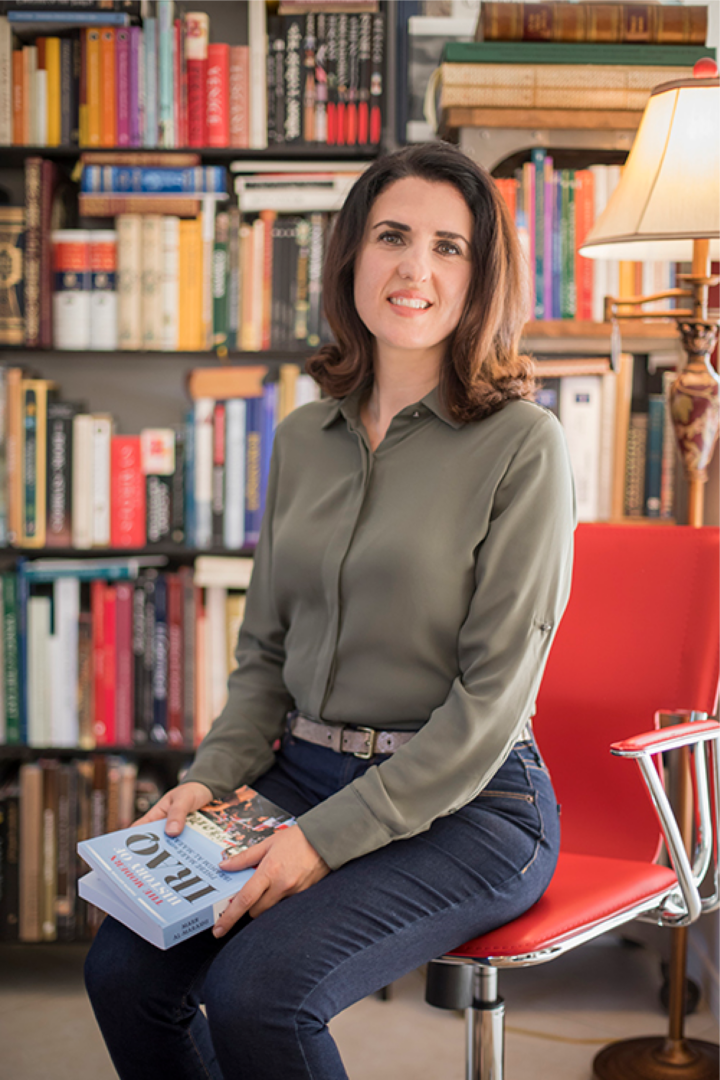
Writer and author Huda Almarashi writes for both children and adults. She’s a co-author of the middle grade novel Grounded, which won the Walter Dean Myers Honor Award, and the author of the memoir First Comes Marriage, My Not-So-Typical American Love Story. Her other writing has appeared in The New York Times, The Washington Post, The LA Times, and Al Jazeera. She’s a fellow and mentor with the Highlights Foundation Muslim Storytellers Program. Her short story, “Not Only and Only,” was featured in the celebrated anthology Once Upon an Eid. Her new book is a middle grade novel titled Hail, Miriam, just out from Penguin. Join us as we discuss how to write what you know.
Powered by RedCircle
Marion: Welcome, Huda.
Huda: Thank you so much for having me.
Marion: Well, it’s a delight to have you here. I had so much fun reading through your work. I learned a lot. I was provoked.
And let’s just lead off with this memoir. Your memoir, First Comes Marriage, My Not-So-Typical American Love Story, was published in 2018 with Prometheus. It is roundly regarded as the first Muslim American memoir dedicated to the themes of love and sexuality. Now, there are somewhere around four million Muslims living in America, and yet this was a first. And I just said, “Wow, wow, that’s complicated.”
So, we’re told to write what we know, but being a first puts a particular kind of pressure on a writer. Did you know that at the time, and how did that affect your thinking?
Huda: I think it’s important to distinguish that when we’re talking about this memoir being a first, we’re talking about it being a first for the Muslim American experience.
And of course, in Muslim majority countries, there’s a whole body of literature that we are not referencing. Muslims in the publishing landscape were extremely underrepresented in the early 2000s, and there’s been a fantastic correction of that. We’re seeing Muslims writing across all genres, and so the representation has vastly improved. But in the early 2000s, when I started writing this, and of course it didn’t get published till 2018, but that’s just a sense of how long it took me, it felt like the scariest thing that I could possibly write was to acknowledge love and relationships and intimacy.
And it also felt like the most important thing I could possibly write, because we had been so pigeonholed into conversations about terrorism, really. And we were always being asked to respond to 9/11. And even though that book didn’t get published until 2018, Marion, I can’t even tell you how much agent responses and reactions that I got that asked me, well, where does this fit with 9/11?
This is when Americans became more interested about Muslims. And so, what you saw in the, like, 2010 onward, any memoir that was written by a Muslim had this token 9/11 chapter where people had to respond to 9/11.
You know, they had to make it meaningful somehow and they had to work it into this art. And that was just something that I refused to do. And I kept having to write back. And even Prometheus, when they offered, they asked me that question, but they accepted my answer. And I wrote back to the editor and I said, you know, you never ask somebody from the white majority to respond to any of the major horrific events – gun violence or anything that has happened that has been committed by a white person in their memoir. This is a book about love and relationships. Why would I respond to this in my memoir? It doesn’t fit. It doesn’t have a place. And that editor accepted my answer. The sale moved forward. But all the way in 2018, that was what we were still being asked to respond to.
Marion: It’s a remarkable answer. And I’m so grateful for the generous answer you just gave because, I mean, you so deftly take on the realities of unmet expectations about what we expect going in and what actually happens. And the circumstances of you and Hadi getting married are remarkable, fascinating. And yet it’s about that absolutely universal thing about, Well, this is what I thought was going to be. And yet this is what I wanted and this is what I get. And so to in any way connect that to 9-11 seems, well, insane.
Huda: Right? Such a stretch.
Marion: A stretch is a nice euphemism for what that is. Yeah.
So, before we move on from that memoir, I want to just back that up by talking. And you talked beautifully about how now it’s not as underserved a population on the bookshelves.
But I don’t think we can talk enough about what it’s like growing up and not seeing yourself on the bookshelves and then becoming a writer. And I’m always interested in asking writers how they transcend that.
The child who doesn’t see herself on the shelves, but growing up to beautifully represent oneself, one’s culture, one’s marriage in the real world in America. So, what happens from childhood to becoming a young writer when you haven’t seen yourself on the shelves?
Huda: That is such an excellent and timeless question. You know, when Facebook first came around, I heard from a friend who I hadn’t heard from since middle school. And she said, did you ever grow up to become a writer? And it shocked me.
It shocked me because I didn’t remember that I had loved reading and writing and books in childhood. And then that was something that possibly from childhood I could have dreamed and imagined to be. It took me my whole adult life to allow myself to have this desire. So, to know that it showed up when I was a kid, it floored me because I never even allowed myself to entertain this thought until I was a young mother.
I went through college thinking that the only way to apply an interest in books and storytelling in an acceptable fashion was to follow in my brother’s footsteps and to become an academic.
He is a well-established professor of Middle Eastern history. And I thought, Okay, I’ll just do the same thing. And then the topic that becomes my memoir, right, is life took a different direction for me. I ended up getting married young and I had children, and I was off the academic path. And I would just quiet myself in the evening hours, you know, the few minutes a mother gets to herself.
Marion: Yeah, I remember those.
Huda: Yeah. And they’re so kind of like dark and desperate hours. And I would ask myself, Well, God, if there was one thing I could do with my life in these moments, what would it be? And this sure and quiet voice used to come to me like I would write. If I could just write, I would write. And I still had so much resistance to this.
And before I gave birth to my second child, I just asked my husband, like, “Don’t buy me a gift. Would you just enroll me in this class that I had seen?”
We were living in New York City at the time, and Gotham Writers Workshop had a one-day memoir workshop. And I just spent one day there, but I still didn’t think this was something I was allowed to do until I stumbled upon the next catalog from Gotham, and the memoir workshop for a full one, now I got enticed, I wanted to take a full one online, was being taught by a Palestinian Arab American teacher. And I truly thought it was a sign from God because I thought, if this Arab woman can teach this class, then I can do this work.
And that’s just it. That’s it. Like, you have to see somebody like you doing the thing so you can imagine doing the thing. And she’s an incredible writer, Susan Muaddi Darraj. And she writes for children and adults. And she’s been a mentor and an inspiration since. But we cannot, right, underestimate the importance of that example.
Marion: No, we can’t. Ever. And it’s led you to being part of the Highlights Foundation Muslim Storytellers Program, which I will put a link to in the transcript. But just briefly, can you just tell us a little bit about that, please?
Huda: That program just went under a name change. So, they’re going to be referred to as Boyd’s Mill. So when you link to them in the show notes, it’ll come up as Boyd’s Mill now. But they had a fantastic grant through the Doris Duke Foundation.
That allowed them to bring on 16 emerging Muslim storytellers from any path, like any part of their career journey. There was an application process. We were selected. And I look back on that, the two years I kind of spent in fellowship there, as one of the signs of when things go right in the world. It was just a pure and good thing that they offered writers.
When we talk about change, right? And when we talk about systemic change, and what institutions could do to create change, that fellowship through the Highlights Foundation felt like, Oh, this is what it would look like. So, the institution of the Highlights Foundation created time and space for us to come together. They offered several in-person retreats. And the ripple effect of that is so profound. So many of the writers I was in fellowship with, of course, have gone on to publish their books. We formed deep friendships and community and mentorship. And this thing has changed the publishing landscape already, but the fruits of it are still being born. And it is going to be seen for years to come. And then they used that first cohort as mentors to do another cohort of Muslim storytellers that was even larger.
So, it’s change in action is what it was. It was applied change. It was fantastic.
Marion: Well, change in action is one of the things I think that is the ripples from the young adult fiction market that I don’t know that most people know, but as of 2022, there are 35 million print copies of young adult fiction books sold each year.
And so, to get into that market is a place to do a great deal of good. And in 2023, you published a co-written novel with three other writers called Grounded. Your co-writers are Aisha Saeed, S.K. Ali, and Jamilah Tompkins-Bigelow. The book is published by Abrams. It’s such a great story.
Thunderstorms ground all flights following a huge Muslim convention and four unlikely kids are thrown together. And you tell it from alternating points of view. And I think that entering that space made me understand a little bit more about you and your intent, and for you to get us to think about the differences that we have, and the conversations we can have around our differences, not just accept differences, or tolerate our differences, but move into them.
And I wonder about that experience writing with those three other writers and where and if that idea of conversation about differences, you know, bred this idea of Grounded, like whose idea was the book and how did the four of you come to discuss it and produce it around this topic of really airing our differences and coming to some kind of conclusion about them?
Huda: Grounded started from a conversation between Aisha Saeed and S.K. Ali, who were editors on the Once Upon an Eid collection. And they had invited me to contribute a story there. And that was really my first introduction to the world of middle grade writing. And I contributed a story to Once Upon an Eid with some trepidation because I’d never written for middle grade audiences.
But it was well-received, both by audiences and Aisha and SK Ali alike. And so they invited me to join them in this collaboration in which, like you said, we were trying to showcase some of the diversity within the Muslim American population, not only just in terms of where we come from, but in levels of practice. We were starting to realize that a lot of the Muslim American literature might have spoke to children of immigrants, but we were first generation ourselves and our children were no longer the children of immigrants. And so, we wanted them also to feel seen in a story about joy, a joyful story. That was a very intentional theme on our part, that this was going to be an adventure story, just like any of the dominant culture get to see them in.
And for me, it was a great teaching exercise as a writer because we collaborated in a way that I have never had the opportunity to do, and many writers will never get the opportunity to do, in that I could see intimately how three other writers approached their drafting and their storytelling. And we plotted live on Zoom, made our decisions about how we were going to move forward, gave each other assignments, right? And each one would do our point of view, come back together, reread it, plot forward again. And I learned so many interesting things about myself.
Like I am such a slow writer. And I am more intuitive. I don’t necessarily outline, but watching the way they outlined has taught me to lean a bit more into outlining. And coming from the space of memoir wasn’t necessarily that great at working with plot and plot points. And I thought, oh my gosh, This is a great idea. This is a great concept. Actually thinking about plot points and just giving people action and giving them the excitement and giving them a great story.
And it was an invitation to so many fantastic things, you know, as a Muslim American to engage in the diversity of our community, to think about joy, and then also to be transformed as a writer.
Marion: Lovely. I love the community aspect of that. And I think it’s one of the greatest pieces of advice that you can give to any writer, which is to find some community because nobody should try to do this alone.
And your home people really can’t help you. You’ve got to get people who are doing it too.
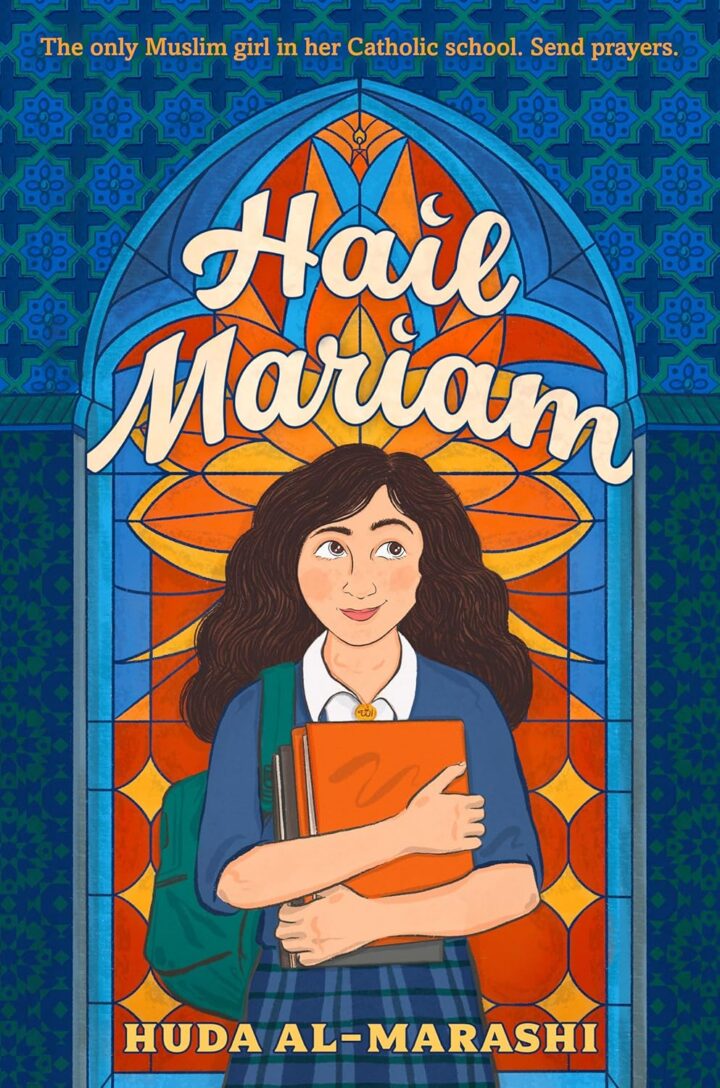
So, in your new book, Hail Miriam, just out from Penguin, on the cover of the book, it says “The only Muslim girl in her Catholic school. Send prayers.” I love that. It’s a middle school interfaith coming of age story. And I must say it is the book for right people. Now, as it shows us the fine art of finding common ground in one of the hottest hotspots in the world: Sixth grade. If you can make it in sixth grade, I think you can make it in the world.
But you take this up a notch by casting Miriam as Mary in the school’s Christmas play. And I cannot thank you enough for that plot point, speaking of plot points, so can you speak a little about your thinking behind that and where you got the idea, please?
Huda: I wish I could say it was pulled from the creative genius of my mind. It was pulled from my own life. I was cast as Mary in the Christmas play when I went to Catholic school myself. But quite boringly, I just said, no.
I thought I was not allowed. And I immediately said, no, I can’t do this. And then I remember it came up later and my mom chuckled. And I remember asking her like, what, what, what’s so funny? And she just laughed and she didn’t say anything. But that laugh told me so much that I had misunderstood something. And it was one of those moments in childhood, you know, where the adults know something and you realize that you’ve kind of missed the point there. And I think that was just a great metaphor for so many things in the religious experience for me, and also my character Miriam, in that she thinks she really gets it.
And she thinks that she can make all the decisions, but there’s a lot of nuance she’s missed out on. So, this was a great moment for me to just expand and to allow her to lean into trying it, to say yes, and then to see what happens and to see how she struggles with accepting this role. And then still at the end, when she is unable to continue for whatever reasons she has reasoned, I did bring back in that mom who kind of has a chuckle about her decision.
Yeah, and who feels that, you know, Miriam has also kind of missed the plot there.
Marion: I think we miss the plot a lot when we ask fiction writers, is this taken from your own life?
Because frequently you’re taking something out to have another look at it, and take it in another direction, and explore where it could go. And so that it doesn’t matter that it’s, quote, “autobiographical in nature.” What matters is that now you have a little control over it, and you can take it in a different direction, perhaps.
And you also, honestly, the opening scene of this book is unforgettable and vivid, where Miriam, a Muslim girl, goes to a sleepover and is bedding down on a friend’s floor under a portrait of Jesus with a flaming heart. And we, from Miriam’s point of view, are immediately able to witness, provoked to consider the anxiety and questions of someone whose own beliefs include that prophets are too holy to be drawn or represented.
And it’s done with directness. It’s graphic. It’s comic. It’s poignant. So, was that your first choice for opening this book, or did that one take some time? Because, boy, talk about writing a perfect lede. That one is perfect.
Huda: Thank you. And this is such a great thing for us to discuss on a podcast for writers.
Marion: Yeah. Because I—before first comes marriage— spent years also trying to draft a memoir about my childhood years. And I had a scene very, very similar to that about my first day in Catholic school and how terrified I was of this crucifix. And I had this line that it was my first day of sixth grade and I was terrified of seeing Jesus. And it never went anywhere. That memoir went into a drawer.
And I didn’t think about it for a long time. When it came to writing this middle grade novel, though, that scene and that opening moment and that fear stayed with me. And for a long time, I used that opening line in the drafts of Hail Miriam, that it was Miriam’s first day of sixth grade and she was afraid of seeing Jesus. And it took me a long time to realize that the book actually needed to start a little bit earlier. And it needed another scene. And then enter the sleepover scene that came also pulled from a moment when I was much younger, much younger than Miriam. But like you said, there was this nugget of inspiration where I remembered being at a neighbor’s house and being so intrigued by her picture of the Sacred Heart of Jesus in her bedroom.
And, so then that appeared there as the opening scene, but what I was trying to do, like you said in your excellent comment about how we pull these moments from our childhood, or from whatever moment in our real life because of what they allow us to show, what I was trying to do with all of those moments is that I think when you’re a part of the dominant culture, you can take for granted that these symbols are normal because they are familiar.
Marion: Yes.
Huda: And it was a chance for me to show how these things might occur to somebody who has no context for them, to which they are not familiar, they are very unfamiliar. And that kind of reaction is universal because I know, I already get to know that you have that reaction when you observe my practices.
Marion: Yes.
Huda: Because I’m from a minority tradition, I’ve had many opportunities to see And here, your knee-jerk reaction to our veiling, to the way we pray, to the sound of the Adhan, like that’s all known to be exotic, known to be something that could be different for somebody else. But now it was my chance to say, “Hey, would you like to see how this occurs to me?”
Marion: Yeah. I thought you just hit it out of the park. And we’re there, you’re in a hot sleeping bag on a floor, and you’re looking up at this. And, we too, are suddenly on a hot sleeping bag on the floor, remembering the first time we were looking at somebody else’s faith, culture, religion, even their food, their anything.
And from a dominant position, perhaps, understanding that we’re not the only. We’re not alone. And maybe we’re not dominant, right? That it’s just a fabulous opening scene. I laughed. I read it several times. I laughed my way through it the first time just in that sheer delight at thinking of you writing it.
And so, I want everybody to buy this book and read it. And I want everybody to buy it considering and thinking about something that I read about from you in an interview with you in which you reflected on your work. And I found this so fascinating.
You offered in part that you hope that your work allows young people to quote, “reimagine their relationship with their elders.” And you dig a little bit deeper talking about young people infantilizing their immigrant parents, equating their parents’ accents and unfamiliarity with American institutions with an inability to understand them and their lives in America.
And you went on to say that you think that storytelling has “the power to remedy this by providing valuable context for experiences that might otherwise feel painfully isolating.” So, I was so touched by this thoughtful intent, and I think that writers right now are wondering what to do, how to take what they want to talk about and put it out there in the world. There’s a lot of fear. There’s a lot of censorship. We’re taking books off the shelves in libraries and in bookstores.
But you, with that quote, provoke us to ask ourselves, and in Hail Miriam, you provoke us to ask ourselves about some hard questions about faith and difference and what we hold on to. So, I’d like you to speak even more, if you would, about the value of locating and digging into the places we think we differ?
Huda: Wow, that’s an amazing question. And thank you for reminding me of that interview and purpose, because it’s honestly something I haven’t thought about for a minute. But I remember one person from my community. I write a lot of the things I write for other Iraqi Americans themselves that I kind of grew up with that were maybe 10, 15 years younger than myself and I’d watch them going through things and struggling with things and feel like I had something to offer.
And I remember one of them coming back to me after she read my book and she said, “You made me feel like my life has context.” And, you know, I could get emotional just thinking of that because like you said, it is such hard work, especially in this hour and in this moment to create because we don’t know where our writing is landing.
We live in a noisy world, right? We live in a noisy world with a lot of entertainment options, with a lot of media, and it’s hard to know where books land for people. But the thing that I have to always go back to, and I invite everybody else to keep going back to, is to keep imagining your audience of one.
Who is that one person that you would do it for again and again and again? Because you know it might change the way they look at something or someone in their life. And I can come up with more than one when I remind myself to do that. And sometimes I think that’s all we can ask is to write to the people that we know need our stories. And that quote that you brought up about infantilizing our elders came from deep listening to my elders and the pain that they felt at being infantilized, at hearing their children mock their accents.
And we think it’s funny. You know, we think it’s delightfully funny. But I remember that aunt telling me, why do they make fun of us? We’re smarter than them. We speak two, they speak one. You know?
Marion: Yeah.
Huda: It comes from a place of great… intelligence and strength and power. And there are role models and we need to make them feel like that too. And so I hope in my stories, I can offer context, constantly going back to that context to maybe show something that a young person may not have realized or imagined about their elders.
Marion: That’s a great answer. It’s a great place to leave it. And I’m so tremendously grateful for your work. Thank you, Huda. It’s a joy to talk to you. And the book is a total delight. I want everyone to read it. Thank you so much.
Huda: Thank you, Marion. I can’t thank you enough for your thoughtful questions.
This was an amazing conversation. Loved every minute of it. The author is Huda Al-Marashi. See more on her at huda almarashi dot com. The book is Hail Miriam, just out from Penguin Young Readers. Get it wherever books are sold. I’m Marion Roach Smith, and you’ve been listening to Qwerty. Qwerty is produced at Overit Studios in Albany, New York. Reach them at overit studios dot com. Our producer is Jacquelin Mignot. Our assistant is Lorna Bailey. Want more on the art and work of writing? Visit marion roach dot com, the home of The Memoir Project, where writers get their needs met through online classes and how to write memoir, including classes on how to write the personal essay and the op-ed. And thanks for listening. Don’t forget to follow Qwerty wherever you get your podcasts and listen to it wherever you go. And if you like what you hear, please leave us a review. It helps others find their way to their writing lives.
Such an illuminating discussion!! Thank you both, so much. I’ve ordered 3 of Huda’s books; the YA ones will go to two girls who are very special in my life. First Comes Marriage is for me to read and add to my collection of memoirs, my favorite genre.