

How To Write From Your True Self
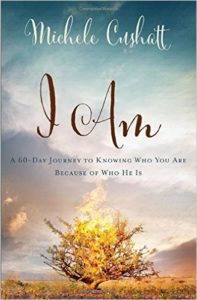
FINDING OUR TRUE SELVES may be one of life’s great journeys, but writing from that place is among the hardest assignments I know. How to write from your true self, and not the one you wished you were, or one who is smarter, wittier or anything else-er? I asked an expert. Let me introduce you to Michele Cushatt, whose new book is just out.
Owning Your Voice:
The Earth Needed to Help Your Reader to Fly
 Let’s say right now, in between all your writing (and social media checking for research, of course) you picked up your phone and punched in the ten numbers of my cell phone.
And what if, let’s say, the phone rang several times before skipping to voice mail.
After a few seconds, you would hear the warm, clear voice of a two-year-younger me greeting you. I’d say things like, “I’m sorry I missed your call,” and “Please leave a brief message and I’ll get right back to you” and the like.
There are two problems with this entire situation. And, yes, it is a situation.
First, the two-year-younger me is lying. Flat out lying. Not intentionally, of course. But lack of malice doesn’t lend any truth. I am not, in fact, sorry I missed your call. And I will not, in fact, get right back to you. I hate the phone and will do most anything to avoid it. Which leads promptly to the second problem with our little situation:
The warm clear voice greeting you claims to be me, but it is not. That woman is no longer alive. She died November 25, 2014. In her place lives a new woman, a woman with the same birth certificate and social security number, a woman with the same husband and children and bottled hair color (“Dark Brown #003”). But a woman who isn’t the same as she once was.
Why? Because cancer stole her speech. And, thus, her life.
Squamous-cell carcinoma of the tongue, they call it. The first time in 2010, then twice more in 2014. The last time, on November 25, 2014, it demanded a nine-hour surgery to remove two-thirds of my tongue and massive reconstruction using tissue from neck, arm and leg.
But that was just the beginning. After a few weeks recovery, I began radical radiation and chemotherapy that left me, for the better part of a year, little more than a couch-bound, narcotic-fogged observer of the so-called good life.
The short of it is this: I slipped into anesthesia as a woman who made her living as a communicator. And I woke up from it a completely different woman. One who will live with a permanent speech and eating disability for the rest of her life. And one who can’t bring herself to change her cell phone voice mail.
In the years following this death and rebirth, I had to rediscover who I was. As you can imagine, it’s been both grueling and enlightening. In this multi-year process of rediscovery, I learned quite a bit about how much identity can either make or break our writing.
You see, as I fought to resurrect my life, I had a book to write. My deadline sat precisely 362 days from that devastating nine-hour surgery. The subject of said book? Finding our true identity.
Oh, the irony.
Thus, as I did hand-to-hand combat with my dwindling identity, I also had to catalogue content on the process. An impossible scenario, initially. A perfect opportunity, ultimately.
Identity is more important to writing that I ever knew.
As writers—especially memoirists—we must write from a place of solid ground. That doesn’t mean we don’t struggle and ache and agonize. If we’d wanted a bland and innocuous writing experience, we would’ve opted for prescriptive non-fiction.
Alas, no. We masochistic memoirists have chosen the bloody path. The one that requires us to do perform self-surgery, page after page. That means, at times we dig and tear and cut not knowing what we might find. Even so, we must do it from a place of secure identity if we want to produce a life-giving result to the reader.
Picture it this way: If you had woken up this morning with severe appendicitis, you wouldn’t have called up your neighbor to do the excision (unless, of course, your neighbor is a reputable surgeon). There’s not a chance you’d allow a scalpel in the hands of anyone less than confident in his skills and credentials.
The same is true for writers. Yes, we often wrestle with cavernous insecurity. We wonder if our words matter, if our stories resonate with the world, if we have what it takes to hack the process and rejection and potential pain. And yet, if we’re not careful, our insecurity will end up becoming a self-fulfilling prophecy. The very hack-writing we want to avoid ends up seeping into the very words we use.
Thus, we must fight against the insecurity trying to pull us under. We must own our voice, flaws and all. After more than two years of struggle, I’m more convinced than ever that a writer must know who she is before she can lead a reader through her story. Here are a few of the differences between a secure writer and an insecure one:
A Secure Writer …
- Follows the story, rather than chasing Desperate to grab the reader’s attention, the insecure writer tries to hard to create (embellish? fabricate?) details for the sake of sensationalism. She doesn’t unearth the story. She smothers it.
- Creates safety for the reader, rather than anxiety. It’s one thing to create tension on every page; another thing to create worry. The secure writer is able to create tension, push conundrums without rampant panic. One leads the reader to a haven in which to explore. The other scares her to the point of running away.
- Focuses on exploration, rather than an agenda. The insecure writer is defensive, self-protective, aimed at writing countermeasures for any potential rebuttal. She explains things that require no explanation, defends things that need no defense. The secure writer, however, knows who she is, what she stands for, and allows the reader to, likewise, be her own person. In other words, she trusts the process, rather than manipulates it.
None of us will do this without flaw. As long as we continue to be living, breathing, in-progress humans, we writers will fall in and out of love with ourselves, and thus in and out of a secure identity. We will vacillate between affirmations and criticisms, both internal and external, sometimes several times a day.
But we mustn’t fail to struggle. Grappling with our identity—knowing who we are, why we are, and what we are about—makes for the best kind of writing. Because only then we can we embrace our truest selves—speech disability and all—and lead our readers to do the same.
Author bio:
Michele’s first book is a memoir titled Undone: A Story of Making Peace With An Unexpected Life (Zondervan, 2015). Her second book, I Am: A 60-Day Journey To Knowing Who You Are Because of Who He Is, (Zondervan, 2017), was released on January 24, 2017. When she isn’t working on her books, Michele writes feature articles, blog posts, stories and devotional meditations for numerous publications including MOPS International, Today’s Christian Woman, InCourage, Fullfill Magazine, Hearts-at-Home, Upper Room, David C. Cook’s Quiet Hour, Standard Publishing’s Devotions, and multiple compilation books including five titles in the Chicken Soup series.
Michele and the love of her life, Troy, live in Colorado with their six children, ages 9 to 24. She enjoys a good novel, a long run, and a kitchen table filled with people. Learn more on Michele Cushatt’s website.
HOW TO WIN A COPY OF THE BOOK
I hope you enjoy Writing Lessons. Featuring well-published writers of our favorite genre, each installment takes on one short topic addressing how to write memoir.
It’s my way of saying thanks for coming by.
Love the author featured above? Did you learn something in the how-to? Then you’ve got to read the book. And you can. I am giving away one copy, and all you have to do to win is leave a comment below about something you learned from the writing lesson or the excerpt. I’ll draw winners at random (using the tool at random dot org) after entries close at midnight Monday, February 27, 2017. Unfortunately, only readers within the US domestic postal service can receive books.
Good luck!
Such a good reminder to not compare writings. We each have our own journey.